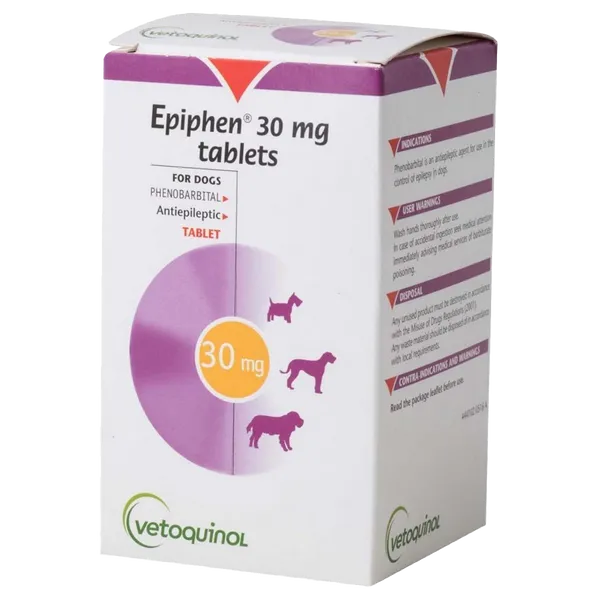
Epiphen (Phenobarbital) 30mg Tablet

Epiphen (Phenobarbital) 30mg 1 Tablet

£0.24

Controlled Drug : We require a valid original prescription posting to us before we dispense this medicine.

Typically dispatched within 3-5 working days. Delivery details

Epiphen (Phenobarbital) 30mg 1 Tablet is a veterinary prescription medicine specifically formulated to help manage and control epilepsy in dogs. As a trusted antiepileptic agent, it plays a vital role in improving the quality of life for your beloved canine companion by reducing the frequency and severity of seizures.

Description

At Weldricks Pharmacy, we understand the importance of reliable and accessible veterinary care. Epiphen (Phenobarbital) 30mg 1 Tablet is a crucial medication for dogs suffering from epilepsy, an often challenging neurological condition.

As a phenobarbital-based treatment, this medication works by stabilising electrical activity in the brain, which in turn helps to prevent epileptic seizures. It is essential to administer Epiphen (Phenobarbital) 30mg 1 Tablet precisely as prescribed by your veterinarian, as the dosage often needs to be tailored to your dog's individual needs and monitored carefully to achieve optimal seizure control.

Being a Prescription Only Medicine (POM-V), Epiphen (Phenobarbital) 30mg 1 Tablet requires a valid prescription from a veterinary surgeon before it can be dispensed. Our aim is to make obtaining vital Vet Prescriptions as straightforward as possible, ensuring your dog receives the care they need efficiently and safely.

Understanding Canine Epilepsy

Epilepsy in dogs can be distressing for both pets and their owners. It is a chronic neurological disorder characterised by recurrent, unprovoked seizures. While the exact cause can vary, phenobarbital, the active ingredient in Epiphen (Phenobarbital) 30mg 1 Tablet, is one of the most commonly prescribed medications for long-term seizure management.

Why Choose Weldricks for Your Pet's Medication?

  • Trusted UK Pharmacy: We are a UK regulated pharmacy, family-run for nearly 100 years, offering professional and reliable service.
  • Convenient & Affordable: Access essential Dog Pharmacy medications with ease, often at competitive prices.
  • Fast & Discreet Delivery: Enjoy free UK delivery on orders over £40, with discreet packaging for your privacy. Next day delivery and Click & Collect options are also available.

We are committed to supporting pet owners in managing their animal's health confidently, providing accessible information and professional care for conditions like epilepsy.

FAQ

What is Epiphen (Phenobarbital) 30mg 1 Tablet used for?

Epiphen (Phenobarbital) 30mg 1 Tablet is a veterinary medicine used to control and manage epilepsy in dogs, helping to reduce the frequency and severity of seizures.

How should Epiphen (Phenobarbital) 30mg 1 Tablet be administered to my dog?

Epiphen (Phenobarbital) 30mg 1 Tablet should be given orally. The exact dosage and frequency will be determined by your veterinary surgeon based on your dog's weight and condition. It's crucial to follow their instructions precisely and not to increase the dose without veterinary guidance, especially during the initial weeks of treatment.

Are there any side effects of Epiphen (Phenobarbital) 30mg 1 Tablet in dogs?

Like all medications, Epiphen (Phenobarbital) 30mg 1 Tablet can cause side effects. Common initial side effects may include drowsiness (somnolence), clumsiness (ataxia), or general listlessness. More serious, but rare, side effects can affect the liver, blood, or behaviour. Always consult your vet if you notice any concerning changes in your dog's health or behaviour.

Why do I need a prescription for Epiphen (Phenobarbital) 30mg 1 Tablet?

Epiphen (Phenobarbital) 30mg 1 Tablet is classified as a Prescription Only Medicine for veterinary use (POM-V) and a Controlled Drug (CD, Schedule 3). This classification means it can only be supplied with a valid prescription from a qualified veterinary surgeon, ensuring it is used safely and appropriately under professional supervision.

How should I store Epiphen (Phenobarbital) 30mg 1 Tablet?

Store Epiphen (Phenobarbital) 30mg 1 Tablet in a dry place, protected from light, and at a temperature not exceeding 25°C. Ensure the container is promptly closed after use and kept in its outer carton. It is essential to keep this medicine out of the sight and reach of children.

Directions

Dogs should be dosed orally. The required dosage will differ to some extent between individuals and with the nature and severity of the disorder.

Method and Route of Administration

  • Start with a dose of 2-5mg per kg bodyweight per day.
  • The dose should be divided and administered twice daily.
  • Steady state serum concentrations are not reached until 1-2 weeks after treatment is initiated. The full effect of the medication does not appear for two weeks and doses should not be increased during this time.
  • If seizures are not being controlled, the dosage may be increased by 20% at a time, with associated monitoring of serum phenobarbital levels.
  • The phenobarbital serum concentration should be checked after steady state has been achieved and if it is less than 15 mg/l (65 µmol/l), the dose may be adjusted accordingly.
  • If seizures recur, the dose may be raised up to a maximum serum concentration of 40 mg/l. High plasma concentrations may be associated with hepatotoxicity.
  • Blood samples should be taken at the same time to allow plasma phenobarbital concentration to be determined, preferably during trough levels, shortly before the next dose of phenobarbital is due.
  • For accuracy of dosing, dogs under 6kg should commence therapy with Epiphen Solution. Tablets are not intended to be subdivided.

Special Storage Conditions

  • Store in a dry place and replace the closure promptly.
  • Do not store above 25°C.
  • Protect from light.
  • Keep the container in the outer carton.
Patient Information Leaflet
Warnings

Special Warnings (User warnings)

  • Wash hands thoroughly after use.
  • In case of accidental ingestion, seek medical attention immediately advising medical services of barbiturate poisoning.
  • Read the package leaflet before use.
  • It is advisable to wear disposable gloves when handling the product, to reduce skin contact.
  • Phenobarbital is a teratogen and developmental neurotoxicant and transfers to breast milk.
  • The product should not be administered by pregnant women, women intending to become pregnant or whose pregnancy status is unknown, as well as lactating women.
  • Ingestion of Phenobarbital can cause neurotoxicity which may prove fatal. Take utmost care that children do not come into any contact with the product. Children are particularly at risk of intoxication.
  • To prevent accidental ingestion of tablets, the container should be closed immediately after withdrawing the required number of tablets for one administration. Part tablets should be placed back into the container and used at the next administration, as even part tablets pose a health risk to small children if ingested. The container should be stored in a safe place out of the sight and reach of children.
  • In case of accidental ingestion, seek medical advice immediately and show the package leaflet or the label to the physician.

Contraindications

Not for use in:

  • Pregnant animals.
  • Animals with impaired hepatic function.
  • Cases of hypersensitivity to the active substance(s), to any other barbiturates or to any of the excipients.
  • Animals with serious renal and/or cardiovascular/respiratory disorders.

Adverse Reactions

The following adverse reactions may occur, often at the start of treatment:

  • Ataxia (incoordination), somnolence (drowsiness), listlessness, and dizziness. In some cases, these effects may persist for the entire duration of treatment.
  • A paradoxical hyperexcitability may occur rarely, particularly after first starting therapy.
  • Polyphagia (increased appetite), polyuria (increased urination), and polydipsia (increased thirst) have been reported rarely, but these effects are usually transitory and disappear with continued medication.
  • Hepatotoxicity (liver damage) may develop very rarely, especially at doses over 20 mg/kg/day or when serum phenobarbital levels are high. Liver function tests are recommended.
  • Phenobarbital can have deleterious effects on stem cells from bone marrow, immunotoxic pancytopenia, and/or neutropenia and anaemia (very rarely).
  • Superficial necrolytic dermatitis (very rarely).
  • Hypoalbuminaemia (low albumin levels) was rarely reported.
  • Phenobarbital may increase the activity of serum alkaline phosphatase and transaminases, which may demonstrate non-pathological changes but could also represent hepatotoxicity; liver function tests are recommended.
  • In very rare cases, change of behaviour such as aggression was reported.
  • If adverse effects are are severe, it is recommended to decrease the daily dose.

Special Precautions for Use in Animals

  • Caution is recommended in animals with impaired hepatic and renal function, hypovolemia, anaemia, and cardiac or respiratory dysfunction.
  • The chance of hepatotoxic side effects can be diminished or delayed using an effective dose that is as low as possible. Monitoring of hepatic parameters is recommended in case of prolonged therapy.
  • It is recommended to assess the clinical pathology of the patient 2-3 weeks after start of treatment and afterwards every 4-6 months, e.g., measurement of hepatic enzymes and serum bile acids.
  • Treating dogs with phenobarbital may lower TT4 or FT4 serum levels; however, this may not be an indication of hypothyroidism unless clinical signs of the disease are present.
  • In stabilised epileptic patients, it is not recommended to switch between phenobarbital formulations. If unavoidable, additional caution should be taken, including more frequent plasma concentration sampling.

Interaction with Other Medicinal Products

  • Phenobarbital may reduce the activity of some drugs by increasing the rate of metabolism through induction of drug-metabolising enzymes in liver microsomes.
  • May induce plasma protein binding (e.g., a1acid glycoprotein, AGP), affecting pharmacokinetics of concurrently administered drugs.
  • The plasmatic concentration of cyclosporine, thyroid hormones, and theophylline is decreased with concurrent administration of phenobarbital.
  • Concurrent use with potassium bromide increases the risk of pancreatitis.
  • Concurrent use with other drugs having a central depressive effect can increase the effect of central depressive drugs.
  • Phenobarbital may enhance the metabolism of, and therefore decrease the effect of, other antiepileptics, chloramphenicol, corticosteroids, doxycycline, beta blockers, and metronidazole.
  • The reliability of oral contraceptives is lower.
  • Phenobarbital may decrease the blood concentration of griseofulvin by reducing its absorption and/or inducing hepatic microsomal enzymes.
  • Drugs that can decrease the convulsive threshold (e.g., quinolones, high doses of β-lactam antibiotic, theophylline, aminophylline, cyclosporine, and propofol) should only be used if really necessary.
  • Use of phenobarbital tablets in conjunction with primidone is not recommended as primidone is predominantly metabolized to phenobarbital.

Overdose (Symptoms, Emergency Procedures, Antidotes)

Overdosage may result in coma, severe respiratory and cardiovascular depression, hypotension and shock leading to renal failure and death. Following recent ingestion, the stomach may be emptied by lavage. The prime objectives of management are intensive symptomatic and supportive therapy with particular attention paid to the maintenance of cardiovascular, respiratory, and renal functions and to the maintenance of electrolyte balance.

Ingredients

Each white tablet contains:

  • Active substance: Phenobarbital 30 mg

Ordering prescription medication is easy

Follow these simple steps

Get a prescription from your Doctor or Vet.

Place your order with us.

Add a pet and upload a prescription.

Our pharmacists will double-check your order & once approved, your order will be dispatched.