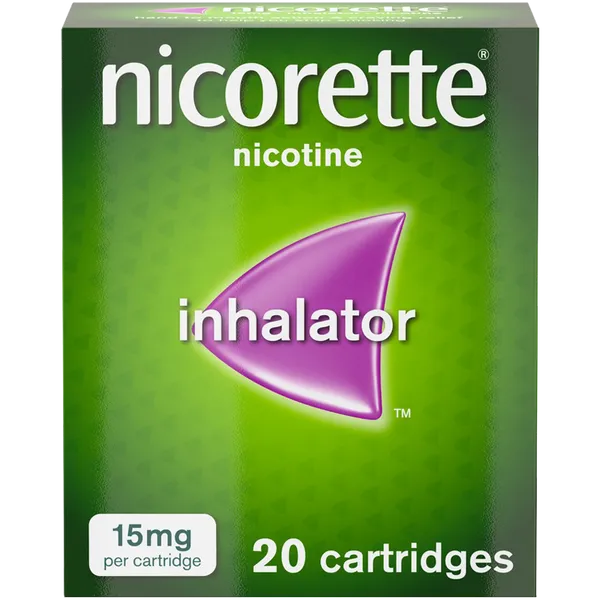
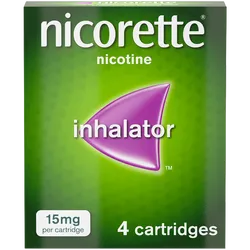
Before using Nicorette 15mg Inhalator
Do not use Nicorette inhalator:
- if you have an allergy to nicotine or any of the other ingredients.
- if you are a child under 12 years of age.
Talk to your doctor, pharmacist or nurse…
- if you are pregnant or breastfeeding – you may be able to use nicotine replacement therapy (NRT) to help you give up smoking/vaping but you should try to give up without it. See "If you are pregnant or breastfeeding" below.
- if you are in hospital because of heart disease (including heart attack, chest pain, disorders of heart rate or rhythm, angina, high blood pressure or stroke). In other heart conditions not requiring you to be in hospital, using NRT is better than continuing to smoke. The risks of continued vaping are not yet established.
- if you have a stomach ulcer, duodenal ulcer, inflammation of the stomach or inflammation of the oesophagus (passage between the mouth and stomach).
- if you have liver or kidney disease.
- if you have a long term respiratory or throat disease or difficulty breathing due to bronchitis, emphysema or asthma. Nicorette inhalator may not be suitable for you to use and you may be advised to use a different type of NRT.
- if you have an overactive thyroid gland or have a phaeochromocytoma (a tumour of the adrenal gland that can affect blood pressure) – your doctor will have told you this.
- if you have diabetes – monitor your blood sugar levels more often when starting to use Nicorette inhalator as you may find your insulin or medication requirements alter.
- if you are taking any other medicines such as theophylline, clozapine or ropinirole. Stopping smoking or cutting down may require the dose of these medicines to be adjusted.
- if you have ever experienced seizures (fits).
- if you have quit smoking/vaping and want to stop using the inhalator but are finding this difficult.
If any of these apply, talk to your doctor, pharmacist or nurse.
Choking hazard: This product contains small cartridges which could be a choking hazard if a child attempts to swallow one. Keep any unused cartridges in the pack out of the sight and reach of children.
If you are pregnant:
- Firstly, you should try to give up smoking/vaping without NRT. Stopping completely is by far the best option. The earlier and quicker you do this the better it is for you and your baby.
- Secondly, if you can't manage this, you can use NRT as a safer alternative to smoking as the risks to your baby are far less than smoking, however you should talk to your doctor, pharmacist or nurse for advice.
The effects of vaping on babies and children are not established. Products that are used intermittently, including Nicorette inhalator may be preferable to nicotine patches. However, patches may be more suitable instead if you have nausea or sickness. If you do use patches take them off before going to bed at night.
If you are breastfeeding:
- Firstly, you should try to give up smoking/vaping without NRT.
- Secondly, if you can't manage this you are best to use NRT products that are taken intermittently (not patches), however you should talk to your doctor, pharmacist or nurse for advice.
Breastfeed just before you use Nicorette inhalator to ensure that the baby gets the smallest amount of nicotine possible.
If you do need to use NRT to help you quit, the amount of nicotine that the baby may receive is considerably smaller and less harmful than the second-hand smoke they would inhale if you smoked. The effects of vaping on your body during pregnancy and breastfeeding are not established. Tobacco smoke produces breathing and other problems in babies and children. The effects of vaping on babies and children are not established.
Nicotine products and children: Nicotine can be very dangerous to children. The amount of nicotine tolerated by adults and adolescents can make children very ill, and can sometimes be fatal. Do not leave your inhalator where children may get hold of it.
If you have used Nicorette inhalator too much: If you have used more than the recommended number of cartridges or have smoked/vaped whilst using Nicorette inhalator, you may experience nausea (feeling sick), vomiting, increased salivation, pain in your abdomen, diarrhoea, sweating, headache, dizziness, hearing disturbance or weakness. If you do get any of these effects contact a doctor or your nearest hospital Accident and Emergency department immediately. Do not smoke or vape. Take the leaflet and the pack with you.
If a child uses an inhalator or swallows a cartridge: Contact a doctor or your nearest hospital Accident and Emergency department immediately if a child under 12 years uses your inhalator, or chews, sucks or swallows a cartridge. Take the leaflet and the pack with you. Nicotine inhalation or ingestion by a child may result in severe poisoning.
Possible side effects
Like all medicines, Nicorette inhalator can have side-effects. As many of the effects are due to nicotine, they can also occur when nicotine is obtained by smoking/vaping.
Stop using Nicorette inhalator, do not smoke/vape and contact a doctor immediately if you notice any of the following: fast heart rate/beat, abnormal beating of the heart, chest palpitations, shortness of breath, seizures (fits), or allergic reactions (swelling of the face, mouth, lips, throat or tongue, itching of the skin, swelling of the skin, ulceration or inflammation of the lining of the mouth, difficulty breathing or dizziness).
Very common side-effects (may affect more than 1 in 10 people): headache, throat irritation, feeling sick (nausea), sore and inflamed mouth, hiccups.
Common side-effects (may affect up to 1 in 10 people): allergic reactions (hypersensitivity), burning sensation in the mouth, dizziness, cough, taste disturbance or loss of taste, tingling or numbness of the hands and feet, blocked nose, stomach pain or discomfort, diarrhoea, dry mouth, indigestion, excessive gas or wind, increased salivation, sickness (vomiting), tiredness (fatigue).
Uncommon side-effects (may affect up to 1 in 100 people): abnormal dreams, sudden reddening of the face and/or neck, high blood pressure, sudden constriction of the small airways of the lung that can cause wheezing and shortness of breath, loss or damage to voice, sneezing, throat tightness, burping (belching), swollen, red, sore tongue, mouth ulcers or blisters, numbness or tingling of the mouth, hives (urticaria), excessive sweating, itching, rash, pain in jaw, unusual weakness, chest discomfort and pain, general feeling of discomfort or being unwell or out of sorts (malaise).
Rare side-effects (may affect up to 1 in 1,000 people): difficulty in swallowing, decreased feeling or sensitivity, especially in the mouth, retching (trying to be sick but bringing nothing up).
Other side-effects (frequency not known): blurred vision, watery eyes, stomach discomfort, redness of the skin, dry throat, lip pain, muscle tightness, a fast and irregular heartbeat (atrial fibrillation).
Effects related to stopping smoking/vaping (nicotine withdrawal): You may experience unwanted effects because by stopping smoking/vaping you have reduced the amount of nicotine you are taking. You may also experience these effects if you under use Nicorette inhalator cartridges before you are ready to reduce your nicotine intake. These effects include irritability or aggression, feeling low, anxiety, restlessness, poor concentration, increased appetite or weight gain, urges to smoke (craving), night-time awakening or sleep disturbance, lowering of heart rate, dizziness, light-headedness, blurry vision, nausea, cough, constipation, bleeding gums, mouth ulcers, swelling of the nasal passages and back of the throat.
Effects of too much nicotine: It is possible to inhale too much nicotine if you use the inhalator in very warm surroundings. You may also get these effects if you are not used to inhaling tobacco smoke or e-cigarettes. These effects include feeling faint, feeling sick (nausea), headache.
When you stop smoking you may also develop mouth ulcers. The reason why this happens is unknown.
If you get any side-effects, talk to your doctor, pharmacist or nurse. This includes any possible side-effects not listed in the leaflet. You can also report side-effects directly via the Yellow Card Scheme at www.mhra.gov.uk/yellowcard or search for MHRA Yellow Card in the Google Play or Apple App Store. By reporting side-effects you can help provide more information on the safety of this medicine.