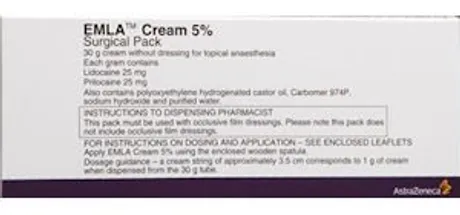
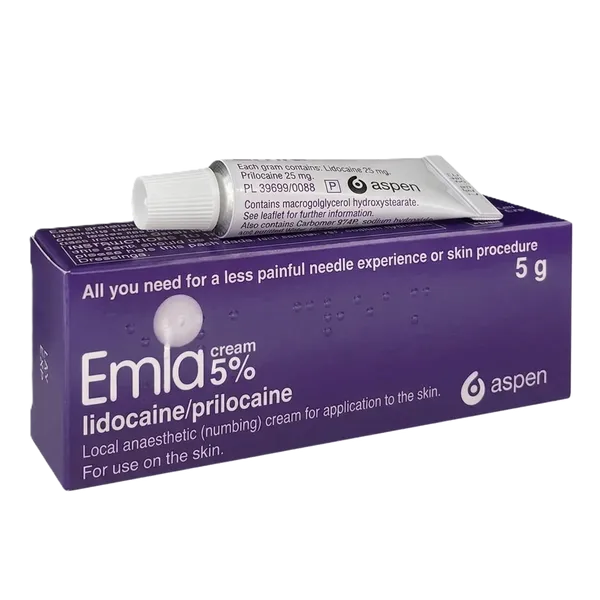
Emla Numbing Cream (Without Dressing) 5g

Emla Numbing Cream (Without Dressing) 5g

£3.39

Prepare for minor medical procedures or skin treatments with greater comfort using Emla Numbing Cream Cream (Without Dressing) 5g. This topical anaesthetic cream, containing lidocaine and prilocaine, effectively numbs the skin's surface to reduce pain and discomfort.

Description

Emla Numbing Cream Cream (Without Dressing) 5g is a trusted local anaesthetic that provides temporary numbing to the skin. Formulated with two active ingredients, lidocaine and prilocaine, it works by blocking pain signals in the skin, making procedures like injections, blood tests, or minor skin operations more manageable. While it reduces the sensation of pain, you may still feel pressure or touch.

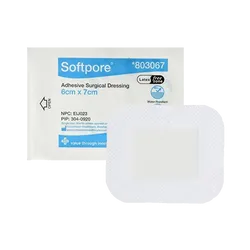
Weldricks Pharmacy offers this convenient 5g tube of Emla Numbing Cream to help you manage discomfort for a variety of uses. Remember, while this pack is supplied without dressings, some applications may require them, which should be sourced separately following advice from your doctor, pharmacist, or nurse.

How Emla Numbing Cream 5g Works

The active ingredients, lidocaine and prilocaine, are local anaesthetics. When applied to the skin, they penetrate the surface layers and temporarily block the nerve signals responsible for transmitting pain. This creates a numbing effect, allowing for greater comfort during:

  • Injections or blood tests
  • Minor skin operations
  • Some types of skin grafting
  • Cleansing and debridement of leg ulcers (under supervision)
  • Genital procedures (under supervision by a doctor or nurse)

Emla Numbing Cream 5g is suitable for adults, adolescents, and children, with specific dosage and application times outlined in the directions for use to ensure safe and effective numbing.

Why Choose Emla Numbing Cream 5g from Weldricks?

At Weldricks Pharmacy, we understand the importance of accessible and professional healthcare. Emla Numbing Cream 5g offers a reliable solution for surface anaesthesia. Our convenient online ordering means you can purchase with ease, benefiting from free UK delivery on orders over £40, discreet packaging, and the reassurance of our 4.9/5 Trustpilot rating from over 85,000 reviews.

FAQ

How long does Emla Numbing Cream (Without Dressing) 30g take to work and how long does it last?

Emla Numbing Cream (Without Dressing) 30g typically takes approximately 60 minutes to achieve its numbing effect for most minor skin procedures. The duration of the numbing effect varies depending on the amount of cream used and the application time, generally lasting for a few hours after removal.

Can children use Emla Numbing Cream 5g?

Yes, Emla Numbing Cream 5g can be used on children, including newborn infants (0-2 months) and older children, for small procedures such as injections or minor skin operations. However, specific dosages, application areas, and maximum application times vary significantly by age. It is crucial to follow the precise instructions from a healthcare professional or the patient information leaflet.

What is Emla Numbing Cream With 2 Dressings 5g used for?

Emla Numbing Cream With 2 Dressings 5g is used to temporarily numb the surface of the skin. This helps to reduce pain and discomfort during minor medical procedures such as injections, blood tests, or minor skin operations, as well as for cleansing leg ulcers or wart removal.

Directions

It can be used to numb the skin before:

  • Having a needle put in (for example, if you are having an injection or a blood test).
  • Minor skin operations.
  • Some types of skin graft.
  • Cleansing and debridement of leg ulcers.

It can also be used on adults to numb the genitals before:

  • Having an injection.
  • Medical procedures such as removal of warts.

A doctor or nurse should supervise the use of EMLA Cream on the genitals.

Where to put the cream, how much to use and how long to leave it on for will depend on what it is needed for. Your doctor, pharmacist or nurse will put the cream on or show you how to do it yourself.

If applying the cream yourself, before you do you must get dressings from your doctor, nurse or pharmacist to use with EMLA.

When EMLA Cream is used on the genitals, a doctor or nurse should supervise its use.

Adults and adolescents aged 12 years and over:

  • Use on the skin before small procedures (such as having a needle put in or minor skin operations): The cream is put on to the skin in a thick layer. Your doctor, pharmacist or nurse will tell you where to put it. The usual dose is 2g applied for 1 to 5 hours under a dressing.
  • Use on the skin before hospital procedures (such as split-skin grafting) that require deeper skin anaesthesia: The usual dose is 1.5 g to 2 g of cream for each area of skin that is 10 cm² (10 square centimetres) in size, applied for 2 to 5 hours under a dressing.
  • Use on larger areas of newly shaven skin before outpatient procedures (such as hair removal techniques): The usual dose is 1.5 g of cream for each area of skin that is 10 cm² (10 square centimetres) in size, applied for 1 to 5 hours under a dressing.
  • Use on genital skin before injections of local anaesthetics (adult men only): The usual dose is 1 g of cream for each area of skin that is 10 cm² (10 square centimetres) in size, applied for 15 minutes under a dressing.
  • Use on genital skin before minor skin surgery (such as removal of warts for adults only): The usual dose is 5 g to 10 g of cream applied for 10 minutes with no dressing. The medical procedure should then start immediately.
  • Use on leg ulcers before cleaning or debridement: The usual dose is 1-2g of cream for each area of skin that is 10 cm2 up to a total of 10 g. The cream is put on under an airtight dressing such as plastic wrap. This is done for 30 to 60 minutes before the ulcer is to be cleansed. Remove the cream with cotton gauze and start cleansing without delay. EMLA Cream can be used before cleansing of leg ulcers for up to 15 times over a period of 1 -2 months.

Children:

Use on the skin before small procedures (such as having a needle put in or minor skin operations) Application time: approx. 1 hour.

  • Newborn infants and infants under the age of 3 months: Up to 1 g of cream on a skin area not larger than 10 square centimetres in size. Application time: 1 hour, not more. Only one single dose should be given in any 24 hour period.
  • Infants aged 3-11 months: Up to 2 g of cream on a total skin area not larger than 20 square centimetres in size. Application time: approx 1 hour, maximum 4 hours.
  • Children aged 1-6 years: Up to 10 g of cream on a total skin area not larger than 100 square centimetres in size. Application time: approx 1 hour, maximum 5 hours.
  • Children aged 7-11 years: Up to 20 g of cream on a total skin area not larger than 200 square centimetres in size. Application time: approx 1 hour, maximum 5 hours.

A maximum of 2 doses at least 12 hours apart may be given to children over 3 months of age in any 24 hour period.

EMLA Cream can be used on children with a skin condition called “atopic dermatitis” but the application time is 30 minutes, no longer.

Cream applied to a circular area with a diameter of about 18 mm (a 1 pence coin) and depth of about 5 mm is equal to 1 g of EMLA cream. Alternatively, a line of cream of about 3.5 cm squeezed from the 30 g tube is equal to 1 g of cream.

When you apply the cream, it is very important to exactly follow the instructions below:

  1. Squeeze the cream into a mound where it is needed on your skin (for example where the needle is going to be put in). A line of cream of about 3.5 cm is equal to 1 g of cream. Do not rub the cream in.
  2. Peel the ‘centre cut-out’ from the dressing.
  3. Peel the paper layer from the dressing.
  4. Remove the covers of the dressing. Then place the dressing carefully over the mound of cream. Do not spread the cream under the dressing.
  5. Remove the plastic backing. Smooth down the edges of the dressing carefully. Then leave it in place for at least 60 minutes.
  6. Your doctor or nurse will take the dressing off and remove the cream just before they do the medical procedure (for example just before the needle is put in).
Patient Information Leaflet
Warnings

Do not use EMLA Cream if:

  • You are allergic (hypersensitive) to lidocaine, prilocaine or any of the other ingredients of EMLA Cream.

Check with your doctor, pharmacist or nurse before using EMLA Cream if:

  • You or your child are anaemic (a blood problem which means you have too few red blood cells).
  • You or your child have a rare inherited illness that affects the blood called ‘glucose-phosphate dehydrogenase deficiency’.
  • You or your child have a problem with blood pigment levels called ‘methaemoglobinaemia’.
  • You or your child have a skin condition called ‘atopic dermatitis’. This is because the cream may need to be put on the skin for a shorter time.
  • Your child is a pre-term newborn infant.
  • Your child is younger than 12 months and is being treated at the same time with other medicines that affect blood pigment levels ‘methaemoglobinaemia’.

Please tell your doctor, pharmacist or nurse if you are taking, or have recently taken, any other medicines. This includes medicines that you buy without a prescription and herbal medicines. This is because EMLA Cream can affect the way some medicines work and some medicines can have an effect on EMLA Cream.

In particular, tell your doctor, pharmacist or nurse if you or your child have recently used or been given any of the following medicines:

  • Medicines called ‘sulphonamides’ such as sulfamethoxazole.
  • Other local anaesthetics.
  • Medicines to treat an uneven heart beat, such as mexiletine or amiodarone.
  • Medicines to treat an uneven heartbeat, such as mexiletine or amiodarone.
  • Cimetidine or beta-blockers, which may cause an increase in the blood levels of lidocaine. This interaction is of no clinical relevance in short-term treatment with EMLA Cream in recommended doses.

Pregnancy, breastfeeding and fertility:

Talk to your doctor, pharmacist or nurse before using EMLA Cream if you are pregnant, may become pregnant or are breast-feeding. The medicines in EMLA Cream (lidocaine and prilocaine) are passed into breast milk; however, the amount is so small that there is generally no risk to the child.

Important information about some of the ingredients of EMLA Cream:

EMLA cream contains polyoxyethylene hydrogenated castor oil. This may cause skin reactions.

Do not use EMLA Cream on the following areas:

  • Cuts, grazes or wounds, excluding leg ulcers.
  • Where there is a skin rash or eczema.
  • In or near the eyes.
  • Inside the nose, ear or mouth.
  • In the back passage (anus).
  • On the genitals of children.

EMLA Cream should not be used on an area of newly shaven skin larger than 600 cm² (600 square centimetres, e.g. 30 cm by 20 cm) in size. The maximum dose is 60 g.

Do not get EMLA Cream in your eyes. If you get EMLA Cream in your eye by mistake, rinse your eye well with lukewarm water or salt (sodium chloride) solution. Be careful to avoid getting anything in your eye until feeling returns.

If EMLA Cream is accidentally swallowed or if you use more EMLA Cream than recommended, talk to your doctor, pharmacist or nurse straight away.

Possible Side Effects:

Like all medicines, EMLA Cream can cause side effects, although not everybody gets them. If any side effects get serious or if you notice any not listed, please tell your doctor, pharmacist or nurse.

  • Severe allergic reactions (rare, affect less than 1 in 1,000 people): Stop use and seek immediate medical attention if you experience rash, shortness of breath, low blood pressure (fainting/dizziness), or swelling of the face, lips, tongue, or other body parts.
  • Common (affect less than 1 in 10 people): Redness, slight swelling, or pale skin where the cream was used. A mild burning, itching, or warmth sensation (common on genital skin).
  • Uncommon (affect less than 1 in 100 people): Mild burning or itching on skin (not genital), tingling sensation, irritation of treated skin during leg ulcer treatment.
  • Rare (affect less than 1 in 1,000 people): Mild allergic reactions (rash or swelling), small red dots on skin (more likely in children with skin problems like atopic dermatitis), eye irritation from accidental contact.

Keep out of the reach and sight of children. Do not store above 30°C and do not freeze. Do not use after the expiry date. Dispose of medicines responsibly; ask your pharmacist for advice.

Ingredients

EMLA Numbing Cream Cream (Without Dressing) 5g contains the active substances:

  • Lidocaine: 25 mg per gram of cream
  • Prilocaine: 25 mg per gram of cream

The other ingredients are:

  • Polyoxyethylene hydrogenated castor oil
  • Carbomer 974P
  • Sodium hydroxide
  • Purified water
Product Information Leaflet

Customer reviews

Leave a review

Be the first!

If you have purchased this item in the past please leave a review.

Write a review

You may also like