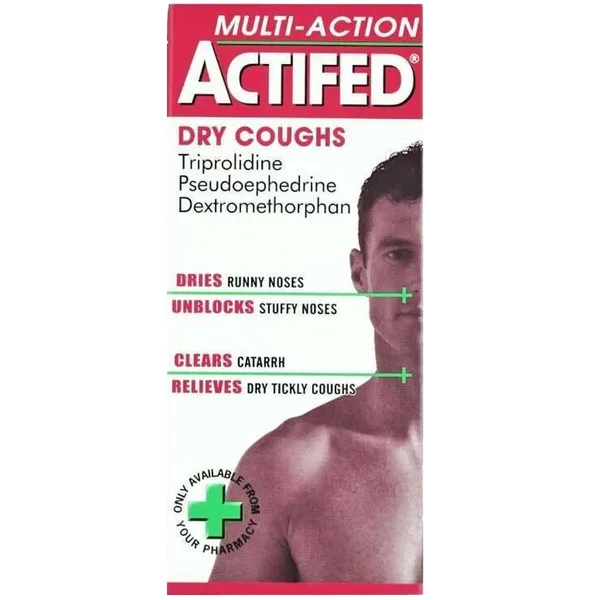
This medicine is suitable for most people but a few people should not use it. If you are in any doubt, talk to your doctor or pharmacist. This medicine can lead to dependence. Therefore the treatment should be of short duration.
Do not take/use Multi-Action Actifed Dry Coughs:
- If you have ever had a bad reaction to pseudoephedrine, triprolidine, dextromethorphan or any of the other ingredients.
- If you suffer from lung disease.
- If you have diabetes.
- If you have a phaeochromocytoma (a rare tumour that affects your heart rate and blood pressure).
- If you have an overactive thyroid gland.
- If you have glaucoma (increased pressure in the eye).
- If you have severe acute (sudden) or chronic (long-term) kidney disease or kidney failure.
- If you have very high blood pressure (severe hypertension) or hypertension not controlled by your medication.
- If you have heart disease.
- If you are taking beta blockers (used to treat high blood pressure).
- If you are taking, or have taken in the last two weeks, drugs for depression known as Monoamine Oxidase Inhibitors (MAOIs) or Reversible Inhibitors of Monoamine Oxidase (RIMAS).
- If you are taking selective serotonin reuptake inhibitors (used to treat depression and anxiety such as fluoxetine, paroxetine and sertraline).
- For children under 12 years old.
If any of these apply to you, get advice from a doctor or pharmacist without using Actifed Multi-Action Dry Coughs 100ml.
Talk to your doctor or pharmacist if...
- If you have kidney or liver problems.
- If you are susceptible to glaucoma (increased pressure in the eye).
- If you have blocked arteries or veins (occlusive vascular disease).
- If you have bronchitis, emphysema or asthma or have had a cough for a few weeks or a cough with a lot of mucus (phlegm).
- If you are being treated for a thyroid disorder.
- If you have difficulty passing water or prostate problems (which may mean you need to pass water more often).
- If you are or have ever been addicted to opioids, alcohol, prescriptions medicines, or illegal drugs.
- If you have previously suffered from withdrawal symptoms such as agitation, anxiety, shaking or sweating, when you have stopped taking alcohol or drugs.
- If you have been told by your doctor that you are a slow metabolizer of CYP2D6.
- If you are taking medicines such as certain antidepressants or antipsychotics this medicine may interact with these medicines and you may experience mental status changes (e.g. agitation, hallucinations, coma), and other effects such as body temperature above 38°C, increase in heart rate, unstable blood pressure, and exaggeration of reflexes, muscular rigidity, lack of coordination and/or gastrointestinal symptoms (e.g. nausea, vomiting, diarrhoea).
- If you are taking any other cough and cold medicines.
- If your child is prone to developing certain allergic reactions (e.g. atopic reactions).
- If you are taking any other medicines, including: Sedatives (drugs used to treat anxiety and tension), Hypnotics (sleeping tablets including barbiturates), Certain drugs for depression such as norepinephrine-dopamine reuptake inhibitors (NDRIs), which include bupropion, Tricyclic antidepressants (used to treat mood disorders), Sympathomimetic drugs (stimulants or appetite suppressants or drugs used to treat congestion and asthma), Anticholinergic drugs (drugs used to treat cramps and spasms such as atropine), Antihypertensives (drugs used to treat high blood pressure such as guanethidine, methyldopa, adrenergic neurone blockers, debrisoquine, bretylium and betanidine), Moclobemide (used to treat mood disorders), Cardiac glycosides (drugs used to control heart rhythms or contractions such as digoxin), Ergot alkaloids (drugs used to treat migraine such as ergotamine and methysergide), Oxytocin (drug used to help contractions during childbirth), Antipsychotics (drugs used to treat mood disorders such as haloperidol, thioridazine, perphenazine), Anti-arrhythmic agents (drugs used to treat an irregular heart beat such as amiodarone, propafenone, quinidine and flecainide), Antifungals (terbinafine), Antihistamines (drugs used to treat the symptoms of allergic reactions).
Taking this medicine regularly, particularly for a long time, can lead to addiction. Only use this medicine as described in the leaflet. Addiction can cause withdrawal symptoms when you stop taking this medicine. Withdrawal symptoms can include restlessness, difficulty sleeping, irritability, agitation, anxiety, feeling your heartbeat (palpitations), increased blood pressure, feeling or being sick, diarrhoea, loss of appetite, shaking, shivering or sweating. Speak to your doctor if you experience withdrawal symptoms.
If you are not sure about any of the medicines you are taking, show the bottle or pack to your pharmacist.
If any of these bullet points apply to you now or in the past, talk to a doctor or pharmacist.
Stop taking this medicine immediately and contact your doctor if you experience:
- A feverish generalised redness of the skin (erythema) associated with pustules.
- Sudden severe headaches, nausea, vomiting, confusion, fits, visual disturbances.
- Sudden abdominal pain or rectal bleeding due to inflammation of the colon (ischemic colitis).
- Sudden loss of vision. Reduction of blood flow to your optic nerve may occur with this medicine.
- Cases of posterior reversible encephalopathy syndrome (PRES) and reversible cerebral vasoconstriction syndrome (RCVS) have been reported following use of medicines containing pseudoephedrine. PRES and RCVS are rare conditions that can involve reduced blood supply to the brain. Stop using Actifed Multi-Action Dry Coughs 100ml immediately and seek immediate medical assistance if you develop symptoms that may be signs of PRES or RCVS.
Pregnancy or breast-feeding
If you are pregnant or breast-feeding, think you may be pregnant or planning to have a baby, ask your doctor or pharmacist for advice before taking this medicine.
Driving and using machines
This medicine may cause drowsiness. If affected, do not operate machinery. Avoid alcoholic drink.
This medicine can affect your ability to drive. Do not drive whilst taking this medicine until you know how this medicine affects you. It may be an offence to drive when taking this medicine if your ability to drive safely is affected. Talk to your doctor or pharmacist if you are not sure whether it is safe for you to drive while taking this medicine. There is further information for patients who are intending to drive in the UK - go to: www.gov.uk/drug-driving-law.
Some of the ingredients can cause problems
- Each 5 ml of this medicine contains 2.8 g of sucrose. This should be taken into account in patients with diabetes mellitus. If you have been told by your doctor that you have an intolerance to some sugars, contact your doctor before taking this medicine.
- This medicine contains 208 mg of alcohol (ethanol) in each 5 ml. The amount in 5 ml of this medicine is equivalent to less than 6 ml beer or 3 ml wine. The small amount of alcohol in this medicine will not have any noticeable effects.
- This medicine contains 5 mg sodium benzoate (E211) in each 5 ml.
- Methyl hydroxybenzoate (E218) may cause allergic reactions (possibly delayed).
- The red colouring, Ponceau 4R (E124) in this medicine may cause allergic reactions.
- This medicine contains 1 g sorbitol in each 5 ml. If your doctor has told you that you (or your child) have an intolerance to some sugars or if you have been diagnosed with hereditary fructose intolerance (HFI), a rare genetic disorder in which a person cannot break down fructose, talk to your doctor before you (or your child) take or receive this medicine. Sorbitol may cause gastrointestinal discomfort and mild laxative effect.
Possible side-effects
Like all medicines, Multi-Action Actifed Dry Coughs can cause side-effects, although not everybody gets them.
If you experience any of the following, stop taking this medicine and seek immediate medical help:
- Reduced blood flow to the heart which can cause angina (discomfort or pain in the chest, neck, back, jaw, shoulders or arms), or heart attack.
- Swelling of the face, lips, mouth, tongue or throat which may cause difficulty in swallowing or breathing.
- Allergic reactions including skin rashes such as hives (which may be severe and include blistering or peeling of the skin) and itching.
- Feeling unusually tired, unexpected bruising or bleeding and getting more infections (such as colds) than normal.
- Hallucinations or paranoid delusions (seeing or hearing things that are not there, irrational thoughts or feelings).
- Sudden onset of fever, reddening of the skin, or many small pustules (possible symptoms of Acute Generalized Exanthematous Pustulosis - AGEP) may occur within the first 2 days of treatment with this medicine.
- Sudden onset of severe headache, nausea, vomiting, confusion, fits, visual disturbances.
- Inflammation of the colon due to insufficient blood supply (ischaemic colitis). Symptoms may include sudden abdominal pain or rectal bleeding.
- Sudden loss or reduction of vision which may be due to reduced blood flow to the optic nerve (ischaemic optic neuropathy).
If you experience any of the following, stop using this medicine and talk to your doctor:
- Trouble passing water (especially in men with prostate problems).
Other effects which may occur include:
Very Common (may affect more than 1 in 10 people)
- Headache
- Difficulty sleeping, dizziness, drowsiness or nervousness
- Difficulty performing tasks
- Blurred vision
- Thickened mucus, dry mouth, upset stomach or nausea
Rare (may affect up to 1 in 1000 people)
- Depression or feeling confused
- Tremors, shakiness or slurred speech
- Low blood pressure
- Sleep disturbances
- An increased awareness of the heartbeat (palpitations)
Other effects which may occur but it is not known how often
- Serious conditions affecting blood vessels in the brain known as posterior reversible encephalopathy syndrome (PRES) and reversible cerebral vasoconstriction syndrome (RCVS). Stop using Multi-Action Actifed Dry Coughs immediately and seek urgent medical attention if you develop symptoms, that may be signs of posterior reversible encephalopathy syndrome (PRES) and reversible cerebral vasoconstriction syndrome (RCVS). These include:
- severe headache with a sudden onset
- feeling sick
- vomiting
- confusion
- seizures changes in vision
- Anxiety, irritability or feeling jittery or feelings of extreme happiness
- Restlessness
- A fast or irregular heartbeat
- Tingling or numbness of the hands or feet (Pins and needles)
- High blood pressure
- Dependence and addiction (see section "How do I know if I am addicted?")
- Dry throat or nose or nose bleeds
- Red rash
- Shallow breathing
- Stomach pain, diarrhoea or vomiting
- Pain when passing water
- Feeling tired
If you forget to take the medicine
If you forget to take a dose, take the next dose when needed provided that the last dose was taken at least 4 hours ago. Do not take a double dose.
Drug Withdrawal
When you stop taking this medicine, you may experience drug withdrawal symptoms, which include restlessness, difficulty sleeping, irritability, agitation, anxiety, feeling your heartbeat (palpitations), increased blood pressure, feeling or being sick, diarrhoea, shaking, shivering or sweating.
How do I know if I am addicted?
If you notice any of the following signs whilst taking this medicine, it could be a sign that you have become addicted.
- You need to take the medicine for longer than advised
- You feel you need to use more than the recommended dose
- You are using the medicine for reasons other than those indicated
- When you stop taking the medicine you feel unwell, and you feel better once taking the medicine again.
If you notice any of these signs, it is important you talk to your doctor or pharmacist.
Storing this medicine
- Do not store this product above 25°C.
- Keep the bottle in the outer carton and away from light.
- Keep this medicine out of the sight and reach of children.
- Do not use this medicine after the expiry date which is stated on the label after EXP. The expiry date refers to the last day of that month.
- Do not throw away any medicines via wastewater or household waste. Ask your pharmacist how to throw away medicines you no longer use. These measures will help protect the environment.

![Common Cold: Symptoms, Treatments & Prevention [Full Guide]](https://d2i5j94z9qxt5a.cloudfront.net/eyJidWNrZXQiOiJ3ZWxkcmlja3MtY2RuIiwia2V5IjoiZ3VpZGVzLzQ2OC9haExxZTNlSHA0OXVWTjk0cTc4aEplN2dwajNvZU1SbEFjdUZpUGRlLmpwZyIsImVkaXRzIjp7InJlc2l6ZSI6eyJ3aWR0aCI6NDYwLCJoZWlnaHQiOjIxNSwiZml0IjoiY292ZXIiLCJiYWNrZ3JvdW5kIjp7InIiOjI1NSwiZyI6MjU1LCJiIjoyNTUsImFscGhhIjowfX0sIndlYnAiOnsicXVhbGl0eSI6ODB9fX0=)