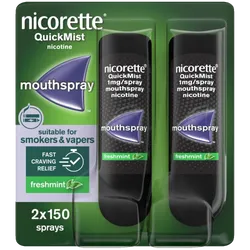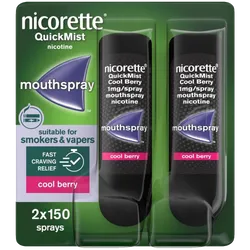
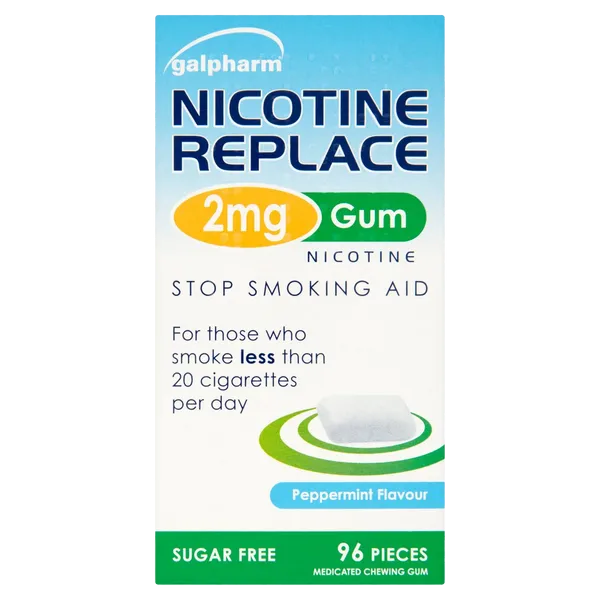
Important Warnings and Precautions for Nicotine Replace 4mg Chewing Gum Peppermint Pack of 96
Do not take this medicine if you:
- Are allergic to nicotine or any of the other ingredients.
- Are under 12 years of age. The level of nicotine in NRT is not suitable for children under 12. Children are more susceptible to the effects of nicotine, and it could cause severe toxicity, which can be fatal.
Talk to your doctor, pharmacist or nurse before taking this medicine if you:
- Are in hospital because of a heart attack, severe heart rhythm disturbances or a stroke. If you have other heart conditions which do not require you to be in hospital, using NRT is better than continuing to smoke.
- Are pregnant or breast-feeding – you may be able to use NRT to help you give up smoking but you should try to give up without it. See "If you are Pregnant or Breast-feeding" section below for more information.
- Have liver or kidney disease.
- Have a stomach ulcer, duodenal ulcer or have inflammation of the oesophagus (oesophagitis), which is the tube leading from the mouth to the stomach.
- Have an uncontrolled, overactive thyroid gland or have been diagnosed as having a tumour of the adrenal glands (phaeochromocytoma).
- Are diabetic, as diabetic patients need to monitor blood sugar levels more closely as nicotine from smoking or from taking the gum may vary them more usual.
- Are taking other medicines such as theophylline, clozapine or ropinirole. When you stop smoking your metabolism slows down and this may alter the way your body responds to certain medicines.
Important information about some of the ingredients in this medicine:
This medicine contains maltitol and sucralose. If you have been told by your doctor that you have an intolerance to some sugars, contact your doctor before taking this medicinal product. This medicine contains butylated hydroxytoluene, which may cause local skin reactions (e.g., contact dermatitis), and local irritation to the eyes and mucous membranes.
If you are Pregnant or Breast-feeding:
If you are pregnant:
- Smoking when you are pregnant is harmful to your baby. If you are pregnant it is best to give up smoking without using NRT. Stopping smoking completely is the best option, and the earlier you stop smoking the better it is for the health of you and your baby.
- If you can't manage stopping smoking, using NRT is a safer alternative than continuing to smoke. However, you should ask for advice from your doctor, nurse or pharmacist. Nicotine 4mg Gum may be more suitable for use than patches as it can be used intermittently. If you have nausea or sickness, patches may be more suitable; however, if you do use patches take them off before going to bed at night.
If you are breast-feeding:
- If you are breast-feeding it is best if you stop smoking without NRT.
- If you do use NRT while breast-feeding, products that are taken intermittently such as gum are best. However, you should talk to your doctor, pharmacist or nurse for more advice.
- Try to breast-feed just before you take the gum, when nicotine levels in your body are at their lowest. That way your baby gets as little nicotine as possible.
- If you do need to use NRT to help you stop smoking, your baby may receive a smaller amount of nicotine and this is less dangerous than breathing in second-hand smoke.
Tobacco smoke is harmful to babies and children, causing breathing difficulties and other problems.
Possible Side Effects
Sometimes there can be some side effects from giving up smoking or using this chewing gum. Some symptoms may be withdrawal symptoms connected with stopping smoking and reducing the amount of nicotine you are taking. These can be: irritability or aggression, feeling low, anxiety, restlessness, poor concentration, increased appetite or weight gain, urges to smoke, night-time awakening, sleep disturbance and lowering of heart rate. Nicotine side effects can generally occur when taking this chewing gum. These effects include: feeling faint, feeling sick, headache and hiccupping (due to excessive swallowing of nicotine).
At the start of treatment the chewing gum may cause a slight throat irritation; it may also cause an increase in salivation. Occasionally, the chewing gum may stick to, and rarely, it may damage dentures.
Very common side effects (more than 1 in every 10 people are affected):
Common side effects (less than 1 in every 10 people are affected):
- Dizziness
- Sickness (vomiting)
Uncommon side effects (less than 1 in every 100 people are affected):
- Irregular heartbeat (palpitations)
- Hives (rashes)
- Redness or itching of the skin
Rare side effects (less than 1 in 1000 people are affected):
- Allergic reactions (swelling of the face, lips and throat (angioedema) which may cause difficulty in swallowing or breathing).
Very rare side effects (less than 1 in 10,000 people are affected):
If any of these side effects get serious, or if you notice side effects not listed in this leaflet, please tell your doctor or pharmacist. After stopping smoking you may develop mouth ulcers; it is not known why this happens.
Reporting of side effects: If you get any side effects, talk to your doctor, pharmacist or nurse. This includes any possible side effects not listed in this leaflet. You can also report side effects directly via the Yellow Card Scheme at: www.mhra.gov.uk/yellowcard. By reporting side effects you can help provide more information on the safety of this medicine.