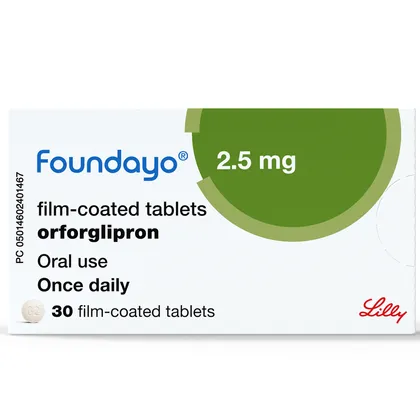
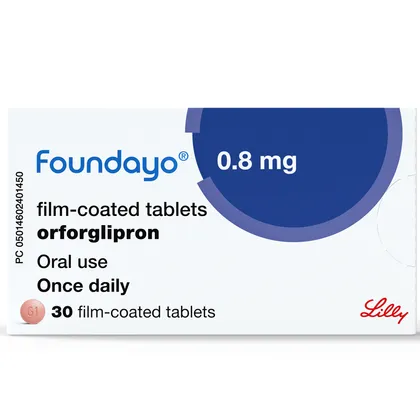
How Foundayo works
Foundayo belongs to a group of medicines called GLP-1 receptor agonists. In everyday terms, it mimics a natural gut hormone called GLP-1 that your body releases after eating. This acts on the appetite centres of the brain, helping you feel fuller for longer and reducing hunger and food cravings, so you naturally eat less. It also slows how quickly your stomach empties.
Foundayo is also separately licensed to improve blood sugar control in adults with insufficiently controlled type 2 diabetes.
A small molecule, not a peptide
Most GLP-1 medicines, including semaglutide (Wegovy) and tirzepatide (Mounjaro), are peptides that get broken down by stomach acid — which is why they're usually injected, or in tablet form need strict empty-stomach rules. Orforglipron's small-molecule structure survives digestion intact, so none of those rules apply.
Once daily, any time
Foundayo is taken as one tablet a day. It can be taken at any time that suits you, with or without food, and there's no need to time it around meals or drink a specific amount of water beforehand.
Gradual dose titration
Like other GLP-1 medicines, treatment starts on a low dose and is gradually increased over several months. This gives your body time to adjust and helps reduce the likelihood of side effects.
Who Foundayo is licensed for
Alongside a reduced-calorie diet and increased physical activity, the MHRA has authorised Foundayo for weight loss and weight maintenance in adults who have:
- A BMI of 30 or above (within the obesity range), or
- A BMI between 27 and 30 (within the overweight range) together with at least one weight-related health condition, such as type 2 diabetes or high blood pressure
It's also separately licensed to improve blood sugar control in adults with insufficiently controlled type 2 diabetes.
Foundayo is not suitable for everyone
- It is not licensed for cosmetic weight loss, or for people who simply want to lose a small amount of weight
- It should not be combined with any other GLP-1 receptor agonist medicine
- It should not be given to children or adolescents under 18, as it has not been studied in this age group
- It should not be used during pregnancy or breastfeeding
Whether Foundayo is appropriate for you is always assessed individually by one of our pharmacists as part of a proper online consultation — taking into account your medical history, current medication and personal circumstances.
Things to tell your pharmacist before you start
Your pharmacist will ask about your medical history and current medicines as part of your consultation. It's particularly important to mention if any of the following apply to you:
- You have, or have ever had, pancreatitis (inflammation of the pancreas)
- You take a sulfonylurea and/or insulin for diabetes, as this can increase the risk of low blood sugar
- You have severe problems with food digestion or stomach emptying (severe gastroparesis)
- You take medicines for high blood pressure, as Foundayo can lower blood pressure further
- You have gallbladder problems, or a history of them
- You have diabetic eye disease (retinopathy) or macular oedema
- You have surgery planned that involves a general anaesthetic
- You have, or have had, severe heart failure
Nausea, vomiting and diarrhoea are common when starting treatment and can lead to dehydration — it's important to keep your fluid intake up, especially if you have any kidney problems.
Pregnancy, breastfeeding and contraception
Foundayo should not be used during pregnancy or while breastfeeding. Effective contraception is recommended while taking it, and if you're planning to become pregnant, treatment should be stopped at least 3 weeks in advance — always discuss this with your pharmacist or doctor first.
Orforglipron can reduce how well oral hormonal contraceptives work. If you take an oral contraceptive, you should also use a barrier method (such as a condom) or switch to a non-oral method of contraception for 30 days after starting Foundayo, and for 30 days after each dose increase.
Other medicines
Always tell your pharmacist about everything else you're taking, including anything bought over the counter. Some medicines can raise the amount of orforglipron in your blood (including clarithromycin, itraconazole, ketoconazole, ritonavir and telaprevir), while others can lower it (including carbamazepine, rifampicin, phenytoin, bosentan, efavirenz and St John's Wort). Foundayo can also raise blood levels of some other medicines, including simvastatin, rosuvastatin and topotecan.
How Foundayo is taken
Treatment starts on the lowest dose and is increased gradually over time. This step-up approach ("titration") gives your body time to adjust and helps reduce the chance of stomach-related side effects. Your pharmacist or prescriber will set your dose and the pace of any increases based on how you respond and how well you tolerate treatment — not everyone needs to reach the highest dose to see meaningful results.
| Step |
Dose |
Minimum time before next increase |
| 1 (starting dose) |
0.8 mg once daily |
At least 30 days |
| 2 |
2.5 mg once daily |
At least 30 days |
| 3 |
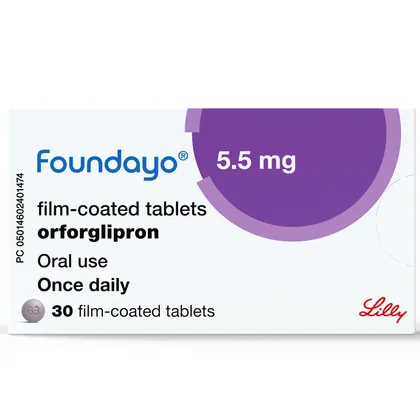
5.5 mg once daily |
At least 30 days |
| 4 (optional) |
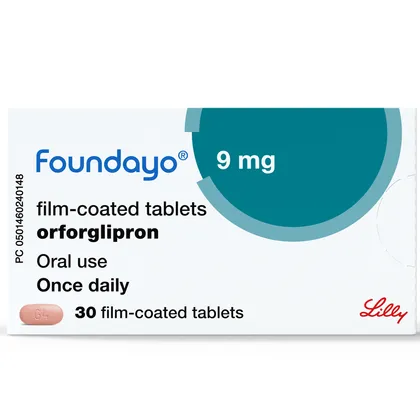
9 mg once daily |
At least 30 days |
| 5 (optional) |
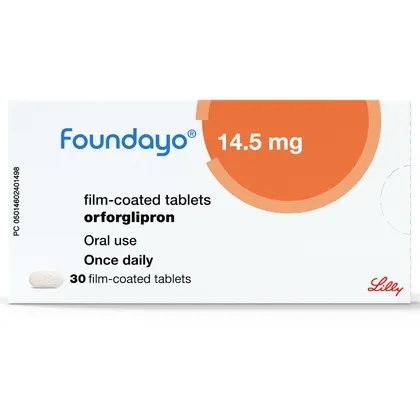
14.5 mg once daily |
At least 30 days |
| 6 (maximum) |
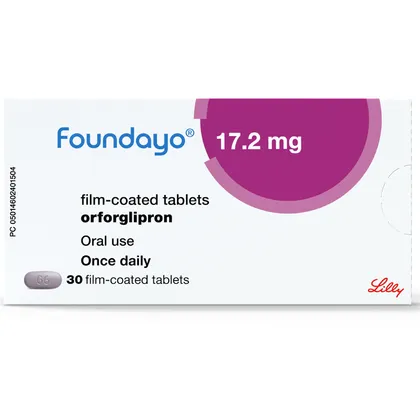
17.2 mg once daily |
— |
Everyone starts on the 0.8 mg dose, regardless of whether it's a first course of treatment or a switch from another weight loss medicine. The maximum licensed dose is 17.2 mg once daily. Always follow the exact schedule set by your pharmacist or prescriber and the patient information leaflet supplied with your medicine — never adjust your own dose.
What the evidence shows
Foundayo's licensing was supported by the ATTAIN Phase 3 trial programme. The figures below are average results after 72 weeks of treatment, taken alongside diet and activity changes — individual results vary considerably, and some people will lose more than the average while others lose less.
Adults with obesity, without diabetes (ATTAIN-1)
Average percentage of body weight lost over 72 weeks, alongside diet and activity changes.
Adults with obesity and type 2 diabetes (ATTAIN-2)
Average percentage of body weight lost over 72 weeks, alongside diet and activity changes. Weight loss is typically lower in trial participants who also have type 2 diabetes, which is consistent with other GLP-1 medicines.
It's worth being upfront: these average results are lower than those seen in trials of injectable Mounjaro (tirzepatide). Some people will value never using a needle and having no food rules enough to accept a smaller average effect; others will prioritise the strongest possible result. Both are reasonable priorities to discuss with a pharmacist.
Sources: MHRA authorisation, 10 August 2026 (gov.uk); ATTAIN-1 (Wharton et al., New England Journal of Medicine, 2025); ATTAIN-2 (Horn et al., The Lancet, 2025).
How Foundayo compares with other UK weight loss medicines
Foundayo is one of four GLP-1 weight loss medicines currently licensed in the UK. Here's how they differ in form and day-to-day routine — this is a comparison of licensed characteristics only, not a recommendation, and trial results between different medicines aren't directly comparable because the studies differ in design and populations.
| Medicine |
Form |
Active ingredient |
Food and water rules |
| Foundayo |
Tablet, once daily |
Orforglipron (small-molecule GLP-1) |
None — any time, with or without food |
| Wegovy tablet |
Tablet, once daily |
Semaglutide (GLP-1) |
Empty stomach, limited water, wait before eating |
| Wegovy injection |
Injection, once weekly |
Semaglutide (GLP-1) |
None |
| Mounjaro |
Injection, once weekly |
Tirzepatide (GIP and GLP-1) |
None |
Mounjaro has shown greater average weight loss in trials than orforglipron to date, generally attributed to its dual GIP and GLP-1 action. Foundayo's trade-off is format: no needles and no fasting rules, which suits some people better than others.
Side effects and safety information
Like all medicines, Foundayo can cause side effects, although not everyone gets them. Most are related to the digestive system, tend to be most noticeable around each dose increase, and usually settle over time — which is one reason treatment is titrated slowly.
Very common (may affect more than 1 in 10 people)
Nausea, constipation, diarrhoea, vomiting, indigestion (dyspepsia) and abdominal pain. These are usually not severe and tend to decrease over time in most patients.
Common (may affect up to 1 in 10 people)
Dizziness, headache, a fast pulse, low blood pressure, bloating, burping, reflux or heartburn, wind (flatulence), gallstones, hair loss, tiredness, and raised pancreatic enzyme levels on blood tests. Low blood sugar can also occur if Foundayo is taken alongside a sulfonylurea or insulin.
Uncommon (may affect up to 1 in 100 people)
Inflamed pancreas (acute pancreatitis) — a serious condition causing severe, persistent pain in the stomach and back, which needs urgent medical attention. Also reported: an unusual sense of taste, and an unusual or unpleasant sensation when touched.
Seek urgent medical help if you notice
Severe, persistent stomach and back pain (possible pancreatitis); sudden changes in your vision; severe or worsening constipation; severe tummy pain or swelling with vomiting or an inability to pass wind or open your bowels (possible bowel obstruction); or signs of a serious allergic reaction such as breathing difficulty, facial or throat swelling, or a fast heartbeat with dizziness or weakness.
Stopping due to side effects
In the ATTAIN-1 trial, between around 1 in 20 and 1 in 10 people taking Foundayo stopped treatment because of side effects, compared with roughly 1 in 37 on placebo.
Important safety information
Foundayo carries a black triangle (△) symbol, meaning it's a newer medicine under additional MHRA monitoring — this is standard for recently licensed medicines and doesn't mean it's less safe, only that extra reporting is encouraged. If you notice any suspected side effect, speak to your pharmacist, GP or nurse and report it through the MHRA Yellow Card scheme. This page is general information and does not replace the advice of your pharmacist or the Patient Information Leaflet supplied with your medicine, which is always the definitive guide.
Ready to find out if Foundayo is right for you?
Our GPhC-registered pharmacists can talk you through eligibility, dosing and what to expect.
Start Your Consultation