Do not use
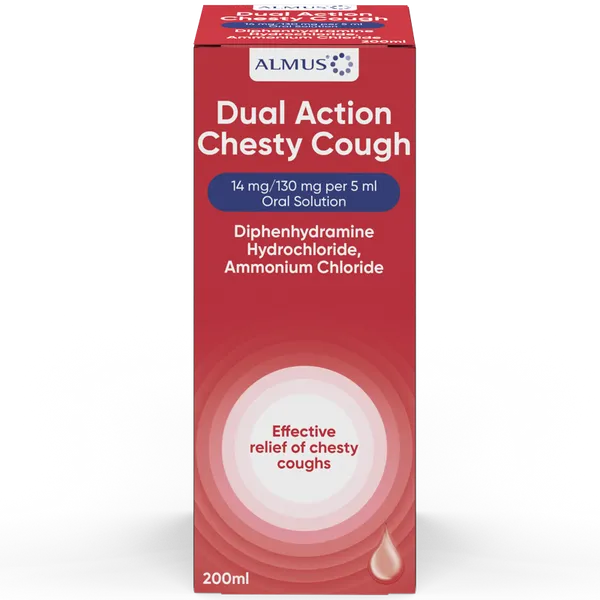
- If you are allergic to diphenhydramine or any of the other ingredients of Dual Action Chesty Cough 14 mg/130 mg per 5 ml Oral Solution.
- If you are breast-feeding, or if you have liver or kidney problems.
- If you are taking medicines for depression such as tranylcypromine, phenelzine or isocarboxazid, or within 14 days of stopping taking these medicines.
- Do not take if you are pregnant.
- Do not use to sedate a child.
Talk to your doctor before use
- If you are suffering from a chronic or persistent cough, if you have asthma, are suffering from an acute asthma attack, or where the cough is accompanied by excessive secretions.
- If you are suffering from an enlarged prostate, urinary retention, angle closure (glaucoma) or liver disease.
- If you have been told by your doctor that you have an intolerance to some sugars, contact your doctor before taking this medicinal product (contains glucose, sucrose and sorbitol).
Further warnings
- This medicine may cause drowsiness. If affected, do not drive or operate machinery. Avoid alcoholic drink.
- Harmful for those suffering from alcoholism. This medicinal product contains 7.2 vol% ethanol (alcohol), i.e. up to 568 mg per 10 ml dose, equivalent to 14.1 ml of beer or 6 ml of wine per 10 ml dose.
- To be taken into account by patients on a controlled sodium diet. This medicinal product contains 33 mg of sodium per 10 ml dose.
- May cause allergic reactions (possibly delayed); contains amaranth (E123) and methylhydroxybenzoate (E218).
- Contains 7.8 g of sucrose per 10 ml dose. This should be taken into account in patients with diabetes mellitus.
- Keep out of sight and reach of children.
Interaction with other medicines
There is an increased risk of side effects such as dry mouth, blurred vision or difficulty passing urine if this medicine is taken with: Parkinson's medicines e.g. procyclidine, orphenadrine, trihexyphenidyl; antipsychotics e.g. chlorpromazine, clozapine, thioridazine; antispasmodics e.g. atropine, propantheline; tricyclic antidepressants e.g. amitriptyline, clomipramine.
There is an increased risk of drowsiness if this medicine is taken with any of the following: alcohol; antipsychotics e.g. chlorpromazine; barbiturates e.g. phenobarbital; anxiety medicines e.g. diazepam, temazepam; sleeping tablets e.g. zopiclone; strong painkillers e.g. morphine, codeine.
Side effects
All medicines can have side effects although they don't affect everyone. Stop using the product and consult your doctor or pharmacist if you notice any of the following:
- Allergic reactions including swelling of the face or difficulty breathing
- Skin rashes or unexplained bruising
- Irregular heartbeat
- Difficulty passing urine
Common side effects: drowsiness (usually diminishes within a few days) — if affected, do not drive or operate machinery and avoid alcoholic drink; excitation, headache, movement (coordination) disorder, urinary retention, dry mouth, blurred vision, stomach upset, thickened chest mucous.
Rare side effects: low blood pressure, involuntary muscle spasm, dizziness, confusion, depression, sleep disturbances, tremor, fits, palpitation, irregular heartbeat, allergy reactions, blood disorders and liver dysfunction.
If you get any side effects, talk to your doctor, pharmacist or nurse. This includes any possible side effects not listed on the label. You can also report side effects directly via the Yellow Card Scheme at yellowcard.mhra.gov.uk. By reporting side effects you can help provide more information on the safety of this medicine.