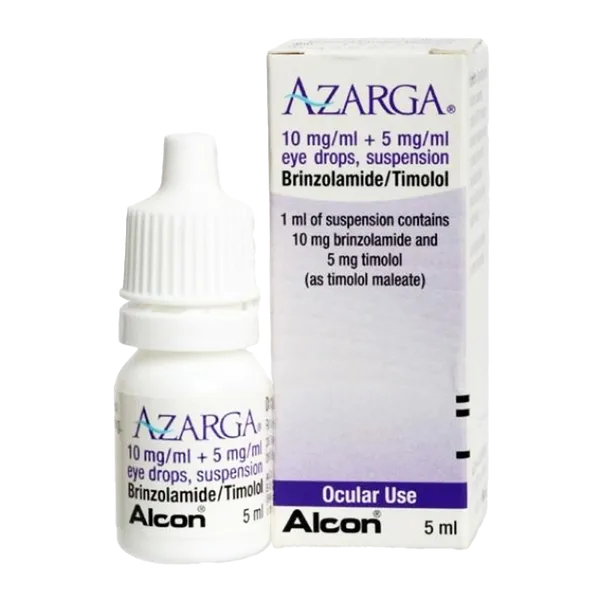
Do not use Azarga if:
- You are allergic to brinzolamide, sulphonamides (medicines for diabetes, infections, diuretics), timolol, beta-blockers (medicines to lower blood pressure or treat heart disease), or any other ingredients of this medicine.
- You have or have had respiratory problems like asthma, severe long-lasting obstructive bronchitis (causing wheezing, breathing difficulty, or chronic cough), or other breathing issues.
- You have a slow heartbeat, heart failure, or disorders of heart rhythm.
- You have severe hay fever.
- You have too much acidity in your blood (hyperchloraemic acidosis).
- You have severe kidney problems.
Warnings and precautions
Azarga 10mg/ml Eye Drops 5ml is for eye use only. If you experience serious reactions or hypersensitivity, stop use immediately and contact your doctor.
Talk to your doctor or pharmacist before using Azarga if you have or have had in the past:
- Coronary heart disease (symptoms may include chest pain, breathlessness), heart failure, low blood pressure.
- Disturbances of heart rate (slow heart beat).
- Breathing problems, asthma, or chronic obstructive pulmonary disease.
- Poor blood circulation disease (e.g., Raynaud's disease).
- Diabetes, as timolol may mask signs of low blood sugar.
- Overactivity of the thyroid gland, as timolol may mask signs of thyroid disease.
- Muscular weakness (myasthenia gravis).
- You are scheduled for an operation, as timolol may affect medicines used during anaesthesia.
- A history of atopy (tendency to develop allergic reactions) or severe allergic reactions; you may be more sensitive to allergic reactions while using Azarga, and adrenaline may be less effective.
- Liver problems.
- Dry eyes or cornea problems.
- Problems with your kidneys.
- Developed severe skin rash, skin peeling, blistering, or mouth sores after using Azarga or similar medicines.
Take special care with Azarga:
Serious skin reactions, including Stevens-Johnson syndrome and toxic epidermal necrolysis, have been reported with brinzolamide treatment. Stop using Azarga and seek medical attention immediately if you notice any related symptoms (severe redness, itching, target-like patches, blisters, skin peeling, ulcers of mouth, throat, nose, genitals, and eyes, potentially preceded by fever and flu-like symptoms).
Children and adolescents
Azarga 10mg/ml Eye Drops 5ml is not recommended for children and adolescents under 18 years.
Other medicines and Azarga
Inform your doctor or pharmacist if you are using, have recently used, or might use any other medicines, including other eye drops for glaucoma. Azarga can affect or be affected by other medicines you are taking, such as those to lower blood pressure (parasympathomimetics, guanetidine), other heart medicines (quinidine, amiodarone, glycosides), diabetes treatments, medicines for gastric ulcers, antifungals, antivirals, antibiotics, or antidepressants (fluoxetine, paroxetine). If you are taking another carbonic anhydrase inhibitor (acetazolamide or dorzolamide), consult your doctor. An increase in pupil size has occasionally been reported when taking Azarga with adrenaline (epinephrine).
Pregnancy and breast-feeding
- Pregnancy: Do not use Azarga 10mg/ml Eye Drops 5ml if you are pregnant or might become pregnant, unless your doctor deems it necessary. Discuss with your doctor before use.
- Breast-feeding: Do not use Azarga if you are breast-feeding, as timolol may pass into your milk. Seek your doctor's advice before taking any medicine during breastfeeding.
Driving and using machines
Do not drive or use machinery until your vision is clear, as it may be blurred for some time after using Azarga. One of the active ingredients may impair mental alertness and physical coordination. Exercise caution when driving or using machines if affected.
Azarga contains benzalkonium chloride
This medicine contains benzalkonium chloride (3.34 µg per drop, equivalent to 0.01% or 0.1 mg/ml), a preservative that can be absorbed by soft contact lenses and may change their colour. Remove contact lenses before using this medicine and wait 15 minutes before reinserting them. Benzalkonium chloride may also cause eye irritation, especially if you have dry eyes or cornea disorders. If you experience abnormal eye sensation, stinging, or pain, consult your doctor.
Possible side effects
Like all medicines, Azarga 10mg/ml Eye Drops 5ml can cause side effects, though not everyone experiences them. Stop using Azarga and seek immediate medical attention if you notice severe redness and itching of the eye, reddish target-like or circular skin patches, blisters, skin peeling, mouth sores (symptoms of Stevens-Johnson syndrome or toxic epidermal necrolysis).
Common side effects (up to 1 in 10 people):
- Eye effects: Eye surface inflammation, blurred vision, signs/symptoms of eye irritation (burning, stinging, itching, tearing, redness), eye pain.
- General effects: Decreased heart rate, taste disturbances.
Uncommon side effects (up to 1 in 100 people):
- Eye effects: Corneal erosion, eye surface inflammation with damage, inflammation inside the eye, corneal staining, abnormal eye sensation, eye discharge, dry eye, tired eyes, itchy eye, eye redness, eyelid redness.
- General effects: Decreased white blood cell count, decreased blood pressure, cough, blood in urine, body weakness.
Rare side effects (up to 1 in 1,000 people):
- Eye effects: Corneal disorder, sensitivity to light, increased tear production, eyelid crusting.
- General effects: Difficulty sleeping (insomnia), throat pain, running nose.
Frequency not known (cannot be estimated from available data):
- Eye effects: Eye allergy, vision disturbance, optic nerve damage, increased eye pressure, deposits on eye surface, decreased eye sensation, conjunctiva inflammation/infection, abnormal/double/reduced vision, increased eye pigmentation, eye surface growth, eye swelling, light sensitivity, decreased eyelash growth/number, drooping upper eyelids, eyelid/gland inflammation, corneal inflammation, detachment of retina layer, visual disturbances, decreased corneal sensitivity.
- General effects: Reddish non-elevated, target-like or circular patches on trunk with central blisters, skin peeling, ulcers of mouth, throat, nose, genitals and eyes (Stevens-Johnson syndrome, toxic epidermal necrolysis).
- Heart and circulation: Changes in heartbeat rhythm/rate, slow/abnormal heart rate, palpitations, chest pain, reduced heart function, heart attack, increased/reduced blood pressure, stroke, oedema, congestive heart failure, swelling of extremities, Raynaud's phenomenon, cold hands/feet.
- Respiratory: Constriction of airways, shortness of breath, breathing difficulty, cold symptoms, chest congestion, sinus infection, sneezing, stuffy/dry nose, nose bleeds, asthma, throat irritation.
- Nervous system and general disorders: Hallucinations, depression, nightmares, memory loss, headache, nervousness, irritability, tiredness, shaking, abnormal feeling, fainting, dizziness, drowsiness, generalised/severe weakness, unusual sensations like pins and needles.
- Gastric: Nausea, vomiting, diarrhoea, intestinal gas/abdominal discomfort, throat inflammation, dry/abnormal sensation in mouth, indigestion, stomach ache.
- Blood: Abnormal liver function values, increased blood chlorine levels, decreased red blood cell count.
- Allergy: Increased allergic symptoms, generalised allergic reactions (swelling beneath skin, obstructed airway, difficulty swallowing/breathing), hives, localised/generalised rash, itchiness, severe sudden life-threatening allergic reaction.
- Ear: Ringing in the ears, sensation of spinning or dizziness.
If you get any side effects, talk to your doctor or pharmacist. You can also report side effects directly via the Yellow Card Scheme (www.mhra.gov.uk/yellowcard) or search for MHRA Yellow Card in app stores. By reporting side effects, you help provide more information on the safety of this medicine.