Keep this medicine out of the sight and reach of children.
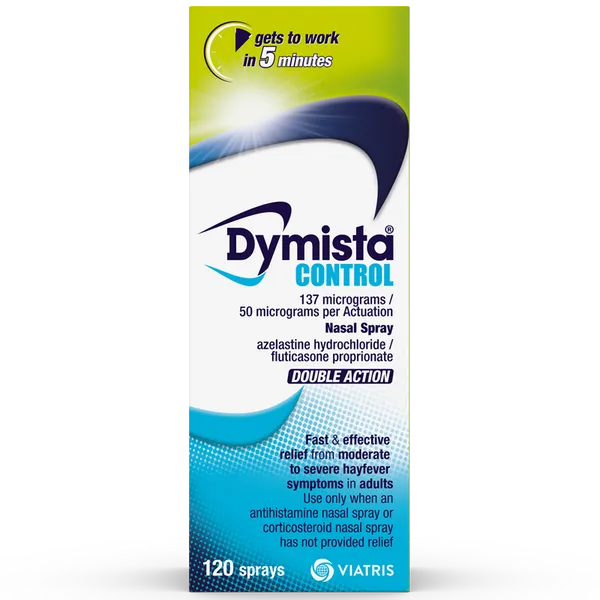
Talk to your doctor or pharmacist before using Dymista Control if:
- You had a recent injury, operation or ulcers in your nose.
- You have a fever or an infection in your nose or sinuses. Infections of the nasal airways should be treated with antibacterial or antifungal medication. If you are given medication for an infection in your nose you can continue to use Dymista Control to treat your hayfever.
- You have tuberculosis or an untreated infection.
- You have a change in vision or a history of increased ocular pressure, glaucoma and/or cataracts. If this applies to you, you will be closely monitored whilst using Dymista Control.
- You suffer from impaired adrenal function. Care must be taken when transferring from systemic steroid treatment to Dymista Nasal Spray.
- You suffer from a severe liver disease. Your risk of suffering from systemic side effects is increased.
In these cases your doctor will decide whether you can use Dymista Nasal Spray. It is important that you take your dose as stated in the directions or as advised by your doctor. Treatment with higher than recommended doses of nasal corticosteroids may result in adrenal suppression, a condition that may produce weight loss, fatigue, muscle weakness, low blood sugar, salt cravings, joint pains, depression and darkening of the skin. If this happens your doctor may recommend another medicine during periods of stress or elective surgery.
To avoid adrenal suppression your doctor will advise you to take the lowest dose at which effective control of your symptoms of rhinitis is maintained.
Taking nasal corticosteroids (such as Dymista) may when taken for a long time cause children and adolescents to grow more slowly. The doctor will check your child's height regularly, and make sure he or she is taking the lowest possible effective dose. Contact your doctor if you experience blurred vision or other visual disturbances. If you are unsure whether the above applies to you, talk to your doctor or pharmacist before using Dymista Nasal Spray.
Children
This medicine is not recommended for children under 12 years.
Other medicines and Dymista Nasal Spray
Tell your doctor or pharmacist, if you are taking, have recently taken or might take any other medicines, including medicines obtained without a prescription. Some medicines may increase the effects of Dymista Nasal Spray and your doctor may wish to monitor you carefully if you are taking these medicines (including some medicines for HIV: ritonavir, cobicistat and medicines for the treatment of fungal infections: ketoconazole).
Pregnancy and breast-feeding
If you are pregnant or breast-feeding, think you may be pregnant or are planning to have a baby, ask your doctor or pharmacist for advice before using Dymista Nasal Spray.
Driving and using machines
Dymista Nasal Spray has minor influence on the ability to drive and use machines. Very rarely, you may experience fatigue or dizziness due to the disease itself or when using Dymista Nasal Spray. In these cases, do not drive or operate machinery. Please be aware that drinking alcohol may enhance these effects.
Dymista Nasal Spray contains benzalkonium chloride
This medicine contains 14 micrograms benzalkonium chloride in each spray, which is equivalent to 0.014 mg / 0.14 g. Benzalkonium chloride may cause irritation or swelling inside the nose, especially if used for a long time. Tell your doctor or pharmacist if you feel discomfort when using the spray.