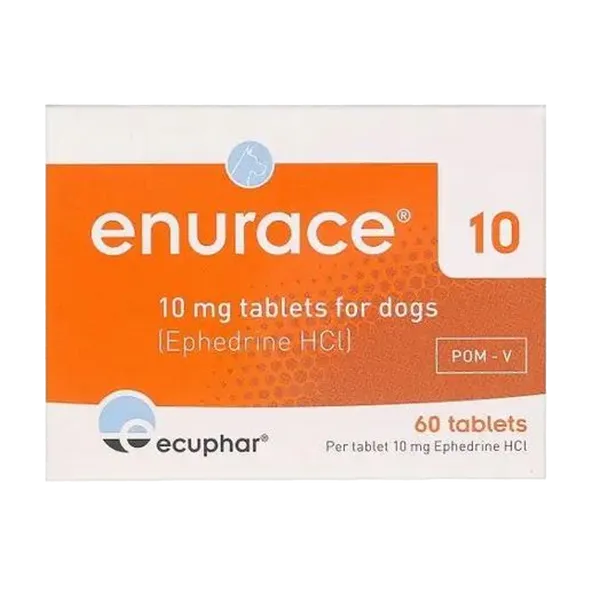
Enurace Tablet for Dogs 10mg

Enurace Tablet for Dogs 10mg

£0.34

Unfortunately the 10mg Enurace has been discontinued by the manufacturer, please speak to your vet about writing a new prescription for the 50mg Enurace, if they judge it suitable.

You need a VET Prescription to purchase this item.

Typically dispatched within 3-5 working days. Delivery details

Enurace Tablet for Dogs 10mg is a veterinary medicinal product prescribed for the treatment of urinary incontinence in ovariohysterectomised (spayed) female dogs. This medication helps manage bladder control issues caused by urethral sphincter mechanism incompetence, allowing your dog to live a more comfortable life.

Description

At Weldricks Pharmacy, we understand the importance of reliable veterinary care. Enurace Tablet for Dogs 10mg provides a targeted solution for a common problem in spayed female dogs. The active substance, Ephedrine Hydrochloride, works to strengthen the urethral sphincter, improving bladder control.

Remember, Enurace Tablet for Dogs 10mg is a prescription-only veterinary medicine. Always consult your vet and follow their instructions carefully. Weldricks Pharmacy makes accessing your pet's vital medications straightforward and convenient, with free UK delivery over £40 and a 4.9/5 rating.

FAQ

Is Enurace 10mg suitable for all dogs?

Enurace Tablet for Dogs 10mg is specifically indicated for ovariohysterectomised female dogs. It should not be used in dogs under 5kg, in dogs with glaucoma, or those with hypersensitivity to Ephedrine or any excipients. It is not suitable for behavioural urination problems.

What are the common side effects of Enurace Tablet for Dogs 10mg?

Side effects can include anxiety and cardiovascular effects (such as increased heart rate). Other potential effects may include sleeplessness, excitation, panting, and changes in intestinal motility. Always discuss any concerns with your veterinarian.

Directions

Directions for Use

For oral administration only.

A starting dose of 2 mg Ephedrine HCl per kg of bodyweight per day, divided into two oral doses, is recommended. Dogs can be dosed according to the following table:

Weight (kg) Dose (mg/day) Dose (Number of tablets)
    per day 1st gift 2nd gift
5 10 1 ½ ½
7.5 15 ½ 1
10 20 2 1 1
12.5 25 1
15 30 3
17.5 35 2

For weights superior or equal to 20 kg, use a higher strength of the product.

Desired therapeutic effect and occurrence of adverse effects have to be monitored approximately at 14 days, 1 month, 3 months and 6 months after the start. Based on the observed effect in comparison with the expected effect and taking into account the occurrence of adverse effects, the individual dose should be adjusted. The dose should be adjusted to find the lowest effective dose.

Once the effective dose has been established, dogs should still be monitored at regular intervals, e.g. every six months.

The product should be administered before meals in a piece of food.

A maximum dose of 5 mg/ kg of bodyweight per day has to be respected.

Patient Information Leaflet
Warnings

Warnings

Contraindications

  • Do not use in dogs with glaucoma.
  • Do not use in case of hypersensitivity to Ephedrine or to any of the excipients.

Special Warnings for Each Target Species

This product is not suitable for treatment of inappropriate urination resulting from behavioural problems.

Special Precautions for Use in Animals

  • The safety and the efficacy of the product has not been assessed in dogs under 5kg. Do not use the product in dogs under 5 kilogram of bodyweight.
  • As ephedrine is an alpha and beta adrenergic receptor agonist, the product should be used with caution in dogs with cardiovascular disease and only after a comprehensive risk/benefit analysis by the attending veterinarian.
  • The dog's cardiovascular functionality should be carefully assessed before the start of the treatment with the product and it should be periodically monitored during the treatment.
  • A similar approach should be adopted in animals suffering from partial urethral obstruction, hypertension, diabetes mellitus, hyperadrenocorticism, hyperthyroidism or other metabolic disorders. It should be mentioned that Polyuria/Polydipsia (PU/PD) frequently accompanying the aforementioned conditions may be falsely diagnosed as urinary incontinence.

Special Precautions to be Taken by the Person Administering the Veterinary Medicinal Product to Animals

  • Ephedrine hydrochloride could be toxic if ingested. Adverse effects may include insomnia and nervousness, dizziness, headache, increased blood pressure, increased sweating and nausea.
  • Ingestion may be fatal, especially in children. To avoid accidental ingestion, the product must be used and kept out of the reach of children. Always replace the cap securely after use.
  • In the event of accidental ingestion, most importantly by children, seek immediate medical attention showing the physician the package insert.
  • It is strongly recommended that pregnant women should wear gloves for administration.
  • Wash hands after administration.

Adverse Reactions (Frequency and Seriousness)

Due to the nature of Ephedrine, the mentioned effects can occur at the recommended therapeutic dose, with anxiety and cardiovascular effects being the most prevalent. In 10% of the treatments, side effects have been observed in efficacy studies. These may include:

  • Cardiovascular effects like tachycardia, atrial fibrillation, stimulation of heart activity, and vasoconstriction.
  • Stimulation of the central nervous system leading to sleeplessness, excitation, anxiety, and muscle tremors.
  • Panting.
  • Mydriasis.
  • Cystitis.
  • Bronchodilatation and decrease of mucus release in the respiratory mucosal membranes.
  • Reduction of the motility and tone of the intestinal wall.

Use during Pregnancy, Lactation or Lay

Not applicable.

Interaction with Other Medicinal Products and Other Forms of Interaction

  • Ephedrine may enhance glucocorticoid metabolism.
  • Ephedrine may interact with other sympathicomimetics.
  • Concomitant use with MAO-inhibitors may cause hypertension.
  • Ephedrine can enhance the activity of products of the same class as theophylline.
  • Volatile anaesthetics may enhance the sensitivity of the myocardium to the cardiovascular effects of Ephedrine.
  • Concomitant use with cardiac glycosides, quinine and tricyclic antidepressants can cause arrhythmias.
  • Vascular constrictions can occur after concomitant treatment with ergot alkaloids and oxytocin.
  • Substances leading to an increase in pH of the urine are able to prolong the excretion of ephedrine, whereas substances leading to a decrease in pH of the urine are able to accelerate the excretion of ephedrine.

Overdose (Symptoms, Emergency Procedures, Antidotes)

The signs of overdose resemble those of the adverse reactions as described in section 'Adverse Reactions'. In case of overdose, it is useful to accelerate excretion of ephedrine by acidification of the urine and enhanced diuresis.

Withdrawal Period(s)

Not applicable.

Special Precautions for Storage

  • Do not store above 25°C.
  • Store in the original container.
  • Divided tablets should be returned in the original package and used in the subsequent dose.
  • Close the cap to the click.

Special Precautions for the Disposal of Unused Veterinary Medicinal Product or Waste Materials

Any unused veterinary medicinal product or waste materials derived from such veterinary medicinal products should be disposed of in accordance with local requirements.

Ingredients

Ingredients

Active substance:

  • 8.1 mg Ephedrine equivalent to 10 mg Ephedrine Hydrochloride.

Excipients:

  • Ponceau 4R (E124) 0.08 mg
  • Colloidal Silica
  • Lactose Monohydrate
  • Maize Starch
  • Magnesium Stearate
Product Information Leaflet

Ordering prescription medication is easy

Follow these simple steps

Get a prescription from your Doctor or Vet.

Place your order with us.

Add a pet and upload a prescription.

Our pharmacists will double-check your order & once approved, your order will be dispatched.