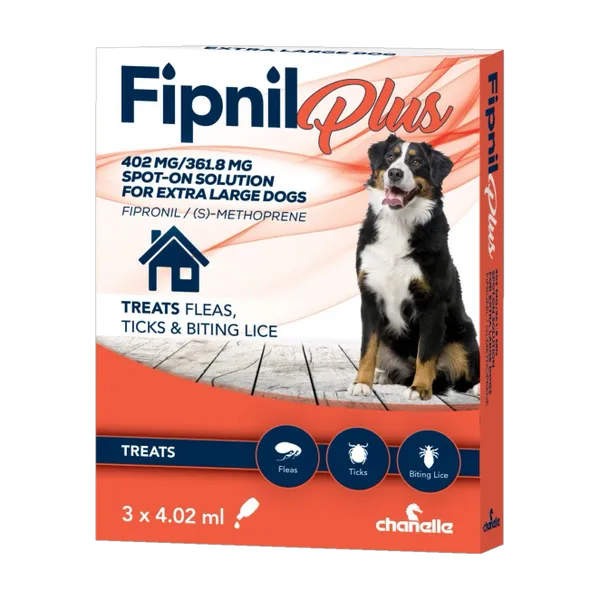
Before use
Do not use:
- In the absence of available data, on puppies less than 8 weeks old.
- On sick (e.g. systemic diseases, fever) or convalescent animals.
- In rabbits, due to a risk of adverse drug reactions or even death. In absence of studies, the use of the product is not recommended in non-target species.
- In cats. This product is specifically developed for dogs; use in cats could lead to overdosing.
- In known cases of hypersensitivity to the active substance or to any of the excipients.
Special warnings:
- Bathing/immersion in water within 2 days after application of the product and more frequent bathing than once a week should be avoided, as no study has been performed to investigate how this affects the efficacy of the product. Emollient shampoos can be used prior to treatment, but reduce the duration of protection against fleas to approximately 5 weeks when used weekly after application of the product. Weekly bathing with a 2% chlorhexidine medicated shampoo did not affect efficacy against fleas during a 6 week long study.
- There may be an attachment of a few ticks. For this reason a transmission of infectious diseases cannot be completely excluded if conditions are unfavourable.
Precautions for use in animals: Avoid contact with the animal's eyes. It is important to make sure that the product is applied to an area where the animal cannot lick it off and to make sure that animals do not lick each other following treatment.
Precautions for the person applying the product:
- This product can cause mucous membrane, skin and eye irritation. Therefore, contact of the product with mouth, skin and eyes should be avoided.
- People with a known hypersensitivity to insecticides or alcohol should avoid contact with the product.
- Avoid contents coming into contact with the fingers. If this occurs, wash hands with soap and water.
- After accidental ocular exposure the eye should be rinsed carefully with clean water.
- If the product is accidentally swallowed, seek medical advice immediately and show the package leaflet to the physician.
- Wash hands after use.
- Treated animals should not be handled until the application site is dry, and children should not be allowed to play with treated animals until the application site is dry. It is therefore recommended that animals are not treated during the day, but should be treated during the early evening, and that recently treated animals are not allowed to sleep with owners, especially children.
- Keep stored pipettes in the original packaging until ready to use. In order to prevent children from getting access to used pipettes, dispose of used pipettes immediately.
- Do not smoke, drink or eat during application.
Environment: Fipronil and (S)-methoprene may adversely affect aquatic organisms. Dogs should not be allowed to swim in watercourses for 2 days after application.
Pregnancy and lactation: The product can be used during pregnancy and lactation.
Interactions: None known.
Side effects and overdose
Side effects: Among the very rare suspected adverse reactions, transient skin reactions on the application site (skin discoloration, local hair loss, itching, redness) and general itching or hair loss have been reported after use. Excessive salivation, reversible nervous signs (increased sensitivity to stimulation, depression, other nervous signs), vomiting or respiratory symptoms have also been observed after use. If licking occurs, a brief period of excessive salivation may be observed due mainly to the nature of the carrier. If you notice any side effects, contact your vet.
Overdose: No adverse effects were observed in target animal safety studies in 8 week-old puppies, growing dogs and dogs weighing about 2 kg treated once at five times the recommended dose. The risk of experiencing adverse effects may however increase when overdosing, so animals should always be treated with the correct pipette size according to bodyweight.
Storage and disposal
- Do not store above 30°C. Store in the original package.
- Any unused veterinary medicinal product or waste materials derived from such veterinary medicinal product should be disposed of in accordance with local requirements.
- Fipronil and (S)-methoprene should not enter water courses as this may be dangerous for fish and other aquatic organisms.