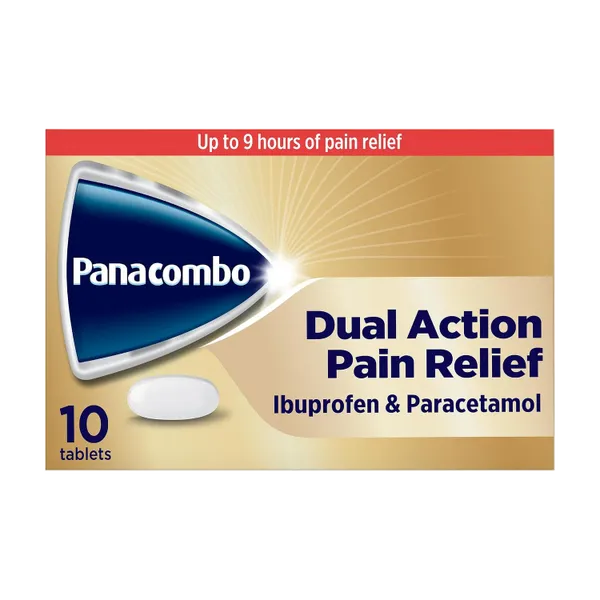
Panacombo Dual Action Pain Relief ibuprofen and paracetamol tablets, pack of 10, front of carton

Panacombo Dual Action Pain Relief Tablets Pack of 10

£3.29
£0.33 per tablet
Save: £0.21
RRP: £3.50

Paracetamol products are limited to a total of 100 tablets/capsules per order.

Limited to 384 ibuprofen tablets

Typically dispatched within 3-5 working days. Delivery details

Panacombo Dual Action Pain Relief Tablets combine ibuprofen 200mg and paracetamol 500mg in each film-coated tablet. They are used for the temporary relief of mild to moderate pain in adults aged 18 and over, but only after ibuprofen or paracetamol taken on its own has not relieved the pain. Panacombo is part of the Panadol range.

Description

Paracetamol and ibuprofen tablets for when one alone isn't enough

Panacombo Dual Action Pain Relief Tablets contain two active ingredients that work in different ways. Ibuprofen belongs to a group of medicines known as non-steroidal anti-inflammatory drugs (NSAIDs), which work by reducing pain, reducing swelling and lowering high temperatures. Paracetamol is an analgesic that works in a different way from ibuprofen to relieve pain and fever.

The tablets are indicated for the temporary relief of mild to moderate pain associated with headache, migraine, backache, period pain, dental pain, rheumatic and muscular pain, cold and flu symptoms, sore throat and fever.

A short-term step up from ibuprofen or paracetamol alone

Panacombo is for short-term use only. For the first day, try a pain reliever with a single active ingredient, either ibuprofen or paracetamol. If that has not relieved your pain during the first day, you can take Panacombo from the next day, for no longer than 3 days. If you would like to know more about either ingredient, read our guide to ibuprofen or browse our pain relief range.

Key features of Panacombo Dual Action Pain Relief Tablets:

  • Two actives in one tablet: ibuprofen 200mg and paracetamol 500mg
  • For adults 18 and over: not for children or adolescents under 18
  • Short-term use: no longer than 3 days
  • Take with food: taking it with food reduces the likelihood of side effects
  • Pack of 10: white or almost white film-coated oval tablets in child-resistant blisters
FAQ

When can I start taking Panacombo Dual Action Pain Relief Tablets?

Panacombo should only be used after trying either ibuprofen or paracetamol on its own. For the first day of treatment, use a pain reliever with a single active ingredient, following its instructions. If your pain has not been relieved during that first day, you can take Panacombo the next day. Do not take Panacombo if your pain has been relieved by ibuprofen or paracetamol on its own.

How many days can I take Panacombo Dual Action Pain Relief Tablets for?

Panacombo is for short-term use only and should not be taken for longer than 3 days. Talk to a doctor if you do not feel better, or if you feel worse, after 3 days.

Can I take Panacombo Dual Action Pain Relief Tablets with other painkillers?

Do not take Panacombo with other products containing paracetamol, or with other NSAID-containing products such as aspirin or ibuprofen. Do not take it if you are taking more than 75mg of aspirin a day. If you take low-dose aspirin (up to 75mg daily), speak to your doctor or pharmacist before taking Panacombo.

Should Panacombo Dual Action Pain Relief Tablets be taken with food?

Yes. Take Panacombo with water and with food, because taking it with food reduces the likelihood of side effects.

Directions

For oral use and for short term use only.

Before you start: for the first day of treatment, try a pain relief medication which contains a single active ingredient (either ibuprofen or paracetamol) in accordance with the product instructions. If during the first day of treatment with such medication your pain has not been relieved, then the next day you can take this medicine following the instructions below.

Adults aged 18 and over:

  • Take 1 tablet with water up to three times a day, with food.
  • Leave at least 6 hours between doses.
  • If one tablet does not control symptoms, then a maximum of 2 tablets may be taken up to three times a day.
  • Do not take more than six tablets in any 24 hour period (equivalent to 3000 mg paracetamol, 1200 mg ibuprofen a day).

Children and adolescents: not for use by children or adolescents under 18 years.

Length of treatment: the lowest effective dose should be used for the shortest duration necessary to relieve symptoms. You should not take this medicine for longer than 3 days. If your symptoms worsen or persist, consult your doctor.

If you have an infection: consult a doctor without delay if symptoms (such as fever and pain) persist or worsen.

If you forget a dose: do not take a double dose to make up for a forgotten dose. Take it as soon as you remember it and then take the next dose at least 6 hours later.

If you take too much: talk to a doctor at once, even if you feel well. This is because too much paracetamol can cause delayed, serious liver damage.

Patient Information Leaflet
Warnings

Do not take Panacombo if you:

  • are already taking any other paracetamol containing products
  • are taking any other pain-relieving products including ibuprofen, high dose aspirin (above 75 mg per day), or other non-steroidal anti-inflammatory drugs (NSAIDs) including cyclo-oxygenase-2 (COX-2) specific inhibitors
  • are allergic to ibuprofen, paracetamol or any other ingredients in this medicine
  • are allergic to aspirin or other NSAID painkillers
  • have or ever had an ulcer or bleeding in your stomach or duodenum (small bowel)
  • have a blood clotting (coagulation) disorder
  • suffer from heart, liver or kidney failure
  • are in the last 3 months of pregnancy
  • are under 18 years old
  • have not tried using either ibuprofen or paracetamol individually to relieve your pain

Talk with your doctor or pharmacist before taking Panacombo if you:

  • are elderly
  • have asthma or have suffered from asthma
  • have kidney, heart, liver or bowel problems
  • have Systemic Lupus Erythematosus (SLE) or other mixed connective tissue disease
  • have gastrointestinal disorders or chronic inflammatory bowel disease (e.g. ulcerative colitis, Crohn's disease)
  • are in the first 6 months of pregnancy or are breastfeeding
  • are planning to become pregnant
  • have an infection, as this medicine may hide signs of infections such as fever and pain
  • have heart problems including heart failure, angina (chest pain), or if you have had a heart attack, bypass surgery, peripheral artery disease, or any kind of stroke (including 'mini-stroke' or transient ischaemic attack "TIA")
  • have high blood pressure, diabetes, high cholesterol, have a family history of heart disease or stroke, or if you are a smoker
  • are taking other medicines, including corticosteroid tablets, antibiotics (e.g. chloramphenicol, quinolones or flucloxacillin), anti-sickness medicines, anti-coagulant medicines (e.g. aspirin, warfarin, ticlopidine), heart stimulants (e.g. glycosides), medicines for high cholesterol (e.g. cholestyramine), diuretics, medicines to reduce high blood pressure, medicines to suppress the immune system (e.g. methotrexate, ciclosporine, tacrolimus), medicines for mania or depression (e.g. lithium or SSRIs), mifepristone or HIV medicines (e.g. zidovudine)

Anti-inflammatory/pain-killer medicines such as ibuprofen may be associated with a small increased risk of heart attack or stroke, particularly when used at high doses. Do not exceed the recommended dose or duration of treatment.

Do not take if you are breastfeeding. This medicine may make it more difficult to become pregnant.

This medicine contains less than 1 mmol sodium (23 mg) per tablet, that is to say essentially 'sodium-free'.

Side effects

Like all medicines, this medicine can cause side effects, although not everybody gets them.

STOP TAKING the medicine and tell your doctor if you experience:

  • heartburn, indigestion
  • signs of intestinal bleeding (severe stomach pain, vomiting blood or liquid with what looks like coffee granules, blood in the stools/motions, black tarry stools)
  • signs of inflammation of the brain lining such as: stiff neck, headache, feeling or being sick, fever or feeling disorientated
  • signs of a severe allergic reaction (swelling of the face, tongue or throat, difficult breathing, worsening of asthma)
  • signs of hypersensitivity and skin reactions such as reddish non-elevated, target-like or circular patches on the trunk, often with central blisters, skin peeling, ulcers of mouth, throat, nose, genitals and eyes
  • high blood pressure, water retention
  • liver problems (causing yellowing of the skin and white of eyes)
  • kidney problems (causing increased or decreased urination, swelling of the legs)
  • heart failure (causing breathlessness, swelling)
  • severe skin reactions including DRESS syndrome (skin rash, fever, swelling of lymph nodes) or a red, scaly widespread rash with bumps under the skin and blisters accompanied by fever (acute generalised exanthematous pustulosis)
  • skin becomes sensitive to light

Common (may affect up to 1 in 10 people): stomach pain or discomfort, feeling or being sick, diarrhoea; higher levels of liver enzymes (shown in blood tests); change in kidney function (shown in blood tests); excessive sweating.

Uncommon (may affect up to 1 in 100 people): headache and dizziness, wind and constipation, skin rashes, swelling of the face, itching; reduction in red blood cells number or increase in platelets.

Very rare (may affect up to 1 in 10,000 people): reduction in blood cells (causing sore throat, mouth ulcers, flu-like symptoms, severe exhaustion, unexplained bleeding, bruising and nosebleeds; stop taking this medicine and contact a doctor at once if this occurs); visual disturbances, ringing in the ears, spinning sensation; confusion, depression, hallucinations; fatigue, generally feeling unwell; mouth ulcer; inflammation of the pancreas; worsening of ulcerative colitis and Crohn's disease; 'pins and needles'; inflammation of the optic nerve, sensitivity to light.

Not known: chest pain, which can be a sign of a potentially serious allergic reaction called Kounis syndrome; a serious condition that can make blood more acidic (metabolic acidosis), in patients with severe illness using paracetamol.

Taking this medicine for longer than the recommended time or at higher than recommended doses puts you at risk of serious harms to the stomach/gut and kidneys, as well as very low levels of potassium in your blood. These can be fatal.

If you get any side effects, talk to your doctor, pharmacist or nurse. You can also report side effects directly via the Yellow Card Scheme at www.mhra.gov.uk/yellowcard.

Keep out of the sight and reach of children.
Ingredients

Active ingredients: each film-coated tablet contains ibuprofen 200 mg and paracetamol 500 mg.

Other ingredients: croscarmellose sodium; hydroxypropylcellulose; microcrystalline cellulose; silica, colloidal anhydrous; stearic acid; magnesium stearate. Film-coating: polyvinyl alcohol, calcium carbonate (E170), carmellose sodium, microcrystalline cellulose, stearic acid.

Product Information Leaflet

External content warning: this link will take you to a third party website.
We cannot guarantee the Patient Information Leaflet is accurate and is for reference only.

View the leaflet

Customer reviews

Leave a review

Be the first!

If you have purchased this item in the past please leave a review.

Write a review