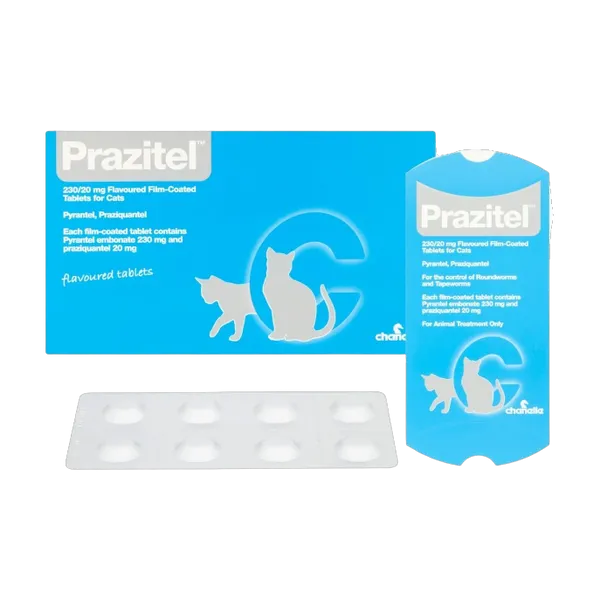
Prazitel 230/20mg Flavoured Film-Coated Tablets for Cats carton with a blister of tablets and the single-tablet pouch.

Prazitel 230/20mg Flavoured Film-Coated Tablets for Cats Pack of 24

£31.98
£1.33 per tablet

Pharmacy medicine : our pharmacists check every order before dispatch.

Typically dispatched within 3-5 working days. Delivery details

Prazitel 230/20mg Flavoured Film-Coated Tablets for Cats are a worming treatment for mixed infections with gastrointestinal roundworms and tapeworms in cats. Each film-coated tablet contains pyrantel embonate 230mg and praziquantel 20mg, given as a single dose of 1 tablet per 4kg bodyweight. This pack contains 24 tablets.

Description

Worming tablets for cats

Prazitel for cats combines two anthelmintics: pyrantel embonate acts against roundworms and praziquantel acts against tapeworms. Together they treat mixed infections with the roundworms Toxocara cati and Toxascaris leonina and the tapeworms Dipylidium caninum, Taenia taeniaeformis and Echinococcus multilocularis.

The tablets are grilled meat flavoured, and each one can be divided into two equal parts. Give the tablet directly to the cat; if necessary, it can be disguised in food.

What Prazitel Flavoured Film-Coated Tablets for Cats are used for:

  • Roundworms: Toxocara cati and Toxascaris leonina.
  • Tapeworms: Dipylidium caninum, Taenia taeniaeformis and Echinococcus multilocularis.
  • 1 tablet per 4kg bodyweight in a single administration, from ½ tablet for cats of 1.0 to 2.0kg up to 2 tablets for 6.1 to 8.0kg.
  • For cats and kittens from 6 weeks of age.
  • 24 film-coated tablets with a break line for halving.

Roundworm in kittens

In ascarid infestation, especially in kittens, complete elimination cannot be expected, so a risk of infection for humans can persist. Kittens should have repeat treatments with a suitable roundworm product at 14 day intervals until 2 to 3 weeks after weaning; ask your vet which product to use. See our flea and worm treatments for cats, our page on worms and our guide to flea and worm treatment for UK pet owners.

FAQ

How many Prazitel tablets does my cat need?

The dose is 1 Prazitel tablet per 4kg bodyweight: ½ tablet for cats of 1.0 to 2.0kg, 1 tablet for 2.1 to 4.0kg, 1½ tablets for 4.1 to 6.0kg and 2 tablets for 6.1 to 8.0kg. Weigh your cat as accurately as possible to get the dose right.

Can Prazitel tablets for cats be given to kittens?

Prazitel tablets for cats can be given to kittens from 6 weeks of age, dosed by weight. Do not use them in kittens less than 6 weeks of age.

Can Prazitel tablets for cats be used in pregnant or nursing cats?

Do not use Prazitel tablets for cats during pregnancy. They can be used during lactation.

How often should kittens be wormed for roundworm?

In roundworm (ascarid) infestation, especially in kittens, complete elimination cannot be expected, so a risk of infection for humans can persist. Repeat treatments should be carried out with a suitable roundworm product at 14 day intervals until 2 to 3 weeks after weaning. Ask your vet which product to use.

Why should fleas be treated alongside Prazitel for cats?

Fleas carry one common type of tapeworm, Dipylidium caninum. Tapeworm infestation is certain to reoccur unless fleas, mice and other sources of re-infestation are also controlled.

Directions

Dosage

For oral use in cats.

To ensure a correct dosage, body weight should be determined as accurately as possible.

The recommended dose is: 20 mg/kg pyrantel (57.5 mg/kg pyrantel embonate) and 5 mg/kg praziquantel in a single administration. This is equivalent to 1 tablet per 4 kg bodyweight.

  • 1.0–2.0 kg: ½ tablet
  • 2.1–4.0 kg: 1 tablet
  • 4.1–6.0 kg: 1½ tablets
  • 6.1–8.0 kg: 2 tablets

Do not use in kittens less than 6 weeks of age.

How to give

The tablet should be given directly to the cat, but if necessary, can be disguised in food.

In ascarid infestation, especially in kittens, complete elimination cannot be expected, so a risk of infection for humans can persist. Repeat treatments should, therefore, be carried out with a suitable roundworm veterinary medicinal product at 14 day intervals until 2-3 weeks after weaning.

If signs of disease persist or appear, consult a veterinary surgeon.

Patient Information Leaflet
Warnings

Before use

Do not use:

  • In kittens less than 6 weeks of age.
  • In cases of hypersensitivity to the active substances or to any of the excipients.
  • During pregnancy.
  • Simultaneously with piperazine compounds.

Special warnings:

  • Fleas serve as intermediate hosts for one common type of tapeworm – Dipylidium caninum. Tapeworm infestation is certain to reoccur unless control of intermediate hosts such as fleas, mice, etc. is undertaken.
  • If there is a risk for re-infestation, the advice of a veterinarian should be sought regarding the need for and the frequency of repeat administration in cats. Local epidemiological information and the living conditions of the cat should be taken into account. It is also important to remove sources of possible re-infestation such as fleas and mice.
  • Parasitic resistance to a certain class of anthelmintics can occur after frequent and repeated use of an anthelmintic from this class.

Precautions for use in cats: As the tablets are flavoured, they should be stored in a safe place out of the reach of animals. Animals in a poor condition or heavily infested, which can be manifested by symptoms such as diarrhoea, vomiting, presence of parasites in faeces and vomit, poor hair condition, should be examined by a veterinarian prior to administration. For severely debilitated or heavily infested cats, use only according to a benefit/risk assessment by the responsible veterinarian.

Precautions for the person giving the tablets: In the interests of good hygiene, persons administering the tablets directly to the cat, or by adding them to the cat's food, should wash their hands afterwards. In case of accidental ingestion, seek medical advice immediately and show the package leaflet or the label to the physician.

Other precautions: Echinococcosis represents a hazard for humans. As Echinococcosis is a notifiable disease to the World Organisation for Animal Health (WOAH), specific guidelines on the treatment and follow-up, and on the safeguard of persons, need to be obtained from the relevant competent authority.

Pregnancy and lactation: Do not use during pregnancy. Can be used during lactation.

Interactions: Do not use simultaneously with piperazine compounds.

Side effects and overdose

Side effects: If you notice any side effects, or think the medicine has not worked, contact your vet. Very rare (fewer than 1 animal in 10,000 treated, including isolated reports): digestive tract disorders (e.g. vomiting and/or hypersalivation); neurological disorders (e.g. ataxia and muscle tremors).

Overdose: After doses higher than 5 times the recommended dose, signs of intolerance such as vomiting have been observed.

Storage and disposal

  • This veterinary medicinal product does not require any special storage conditions.
  • Unused half tablets must be discarded.
  • Any unused veterinary medicinal product or waste materials derived from such veterinary medicinal product should be disposed of in accordance with local requirements.
Ingredients

Active ingredients (per tablet): Pyrantel embonate 230 mg, Praziquantel 20 mg.

Other ingredients: Core tablet: Maize starch, Microcrystalline cellulose, Crospovidone, Magnesium stearate, Colloidal anhydrous silica. Film coat: Grilled meat flavour, Opadry II White consisting of Polyvinyl Alcohol, Titanium Dioxide (E171), Macrogol 3350 and Talc (E553b).

Product Information Leaflet

External content warning: this link will take you to a third party website.
We cannot guarantee the Patient Information Leaflet is accurate and is for reference only.

View the leaflet

Customer reviews

Leave a review

Be the first!

If you have purchased this item in the past please leave a review.

Write a review