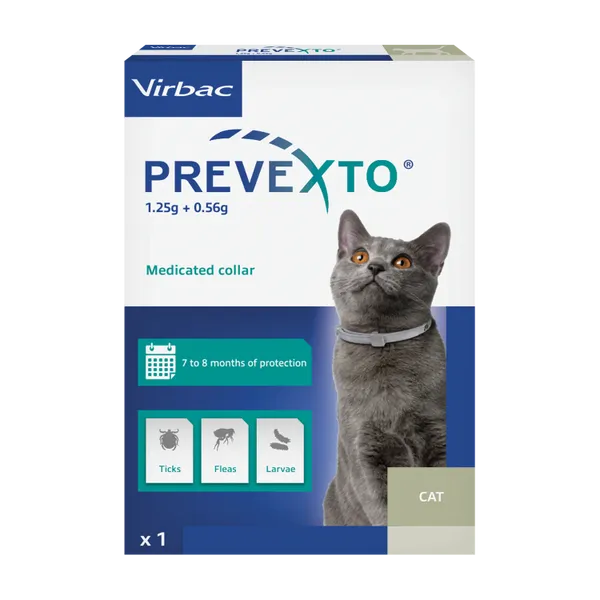
Before use
Do not use:
- On kittens less than 10 weeks of age.
- In cases of hypersensitivity to the active substances or to any of the excipients.
Special warnings:
- Ticks already on the cat prior to treatment may not be killed within 48 hours after collar application and may remain attached and visible. Therefore removal of ticks already on the cat at the time of application is recommended. If you are unsure how to safely remove ticks from your animal, seek professional guidance. The prevention of infestations with new ticks starts within two days after application of the collar.
- Ticks will be killed and fall off the host within 24 to 48 hours after infestation without having had a blood meal, as a rule. An attachment of single ticks after treatment cannot be excluded. For this reason, a transmission of infectious diseases by ticks cannot be completely excluded if conditions are unfavourable.
- In the absence of risk of co-infestation by fleas and ticks, a narrow spectrum product should be used.
- Unnecessary use of antiparasitics or use deviating from the instructions given in the SPC may increase the resistance selection pressure and lead to reduced efficacy. The decision to use the product should be based on confirmation of the parasitic species and burden, or of the risk of infestation based on its epidemiological features, for each individual.
- Ideally, the collar should be applied before the beginning of the flea or tick season. Periods of excessive seasonal hair shedding may lead to transient slight reduction of efficacy by loss of hair-bound portions of the active ingredients. Replenishment from the collar starts immediately so that full efficacy will be re-established without any additional treatment or collar replacement.
- For optimum control of flea problems in heavily infested households it may be necessary to treat the environment with a suitable insecticide. Fleas can infest pets' beds, sleeping areas and usual resting areas like rugs and sofas. In the event of a massive infestation, these places should be treated with a suitable insecticide and vacuumed regularly.
- The possibility that other animals in the same household can be a source of re-infestation with fleas or ticks should be considered, and these should be treated as necessary with an appropriate product.
- The collar is water resistant; it remains effective if the animal becomes wet. However, shampooing or prolonged, intense exposure to water should be avoided as the duration of activity may be reduced.
Precautions for the person fitting the collar:
- Accidental ingestion of the collar can induce adverse effects, including neurotoxic effects. Avoid oral exposure or accidental ingestion, especially by children.
- Keep the sachet with the collar in the outer packaging until use and keep the collar in the sachet until use. Do not allow small children to play with the collar, or to put it into their mouth. Immediately dispose of any remnants or cut-offs of the collar.
- In case of oral exposure or accidental ingestion, seek immediate medical advice and show the package leaflet or the label to the physician.
- The collar may cause hypersensitivity reactions in some people. People with known hypersensitivity (allergy) to the ingredients of the collar, or iron oxide, should avoid contact with the collar and the treated animal. In case of hypersensitive reactions seek medical advice and show the package leaflet or the label to the physician.
- The collar may cause skin, eye and respiratory irritation in some people in very rare cases. Avoid eye and skin contacts. In case of eye irritation, flush eyes thoroughly with cold water. In case of skin irritation, wash the skin with soap and cold water. If symptoms persist, it is recommended to seek medical advice and show the package leaflet or the label to the physician.
- Imidacloprid and flumethrin are continuously released from the collar to the skin and fur whilst the collar is being worn. Avoid prolonged contact with the collar when placing it on the animal and also when it is worn by the treated animal. This especially applies to pregnant women.
- Wash hands with cold water after fitting the collar.
- Pets wearing the collar should not be allowed to sleep in the same bed as their owners, especially children.
Environment: Imidacloprid and flumethrin may adversely affect aquatic organisms. Imidacloprid containing products are toxic to honey bees.
Pregnancy and lactation: The safety of the collar has not been established in target animals during pregnancy and lactation or in breeding animals. The use is not recommended during pregnancy and lactation.
Interactions: None known.
Side effects and overdose
If you notice any side effects, or think the collar is not working, contact your vet. Remove the collar where advised below.
Uncommon (1 to 10 animals in 1,000 treated): application site reaction (e.g. erythema, hair loss, pruritus). Signs usually resolve within 1 to 2 weeks. In single cases, temporary collar removal is recommended until signs resolve.
Rare (1 to 10 animals in 10,000 treated):
- Application site reaction (e.g. dermatitis, eczema, haemorrhage, inflammation, lesion, scratching). Collar removal is recommended.
- Behavioural disorder (e.g. excessive chewing, licking and grooming at the application site, hiding, hyperactivity, vocalisation). May be observed in animals that are not used to wearing collars on the first few days after fitting.
- Diarrhoea, hypersalivation, vomiting, change in food intake, depression: slight and transient reactions that might occur with initial use.
Very rare (less than 1 animal in 10,000 treated, including isolated reports): aggression. Ensure that collar is fitted correctly.
Undetermined frequency: contact dermatitis, noted in hypersensitive animals.
Overdose: Due to the nature of the collar, overdose is unlikely and signs of overdose are not to be expected. An overdose of 5 collars around the neck was investigated in adult cats for an 8 month period and in 10 week old kittens for a 6 month period and no other adverse effects were observed than already described above. In the unlikely event of the animal eating the collar, mild gastrointestinal symptoms (e.g. loose stool) may occur.
Storage and disposal
- Keep the sachet in the outer carton until use.
- Medicines should not be disposed of via wastewater. The collar should not enter water courses as imidacloprid and flumethrin may be dangerous for fish and other aquatic organisms.
- Use take-back schemes for the disposal of any unused veterinary medicinal product or waste materials derived thereof in accordance with local requirements and with any national collection systems applicable to the veterinary medicinal product concerned.