Do not take this medicine if:
- You are allergic (hypersensitive) to dextromethorphan hydrobromide or any of the other ingredients in this medicine.
- You have a chest infection, worsening asthma or severe respiratory problems.
- You are currently taking a prescription monoamine oxidase inhibitor (MAOI), used to treat depression and Parkinson's disease or have taken this medicine in the last 14 days.
- You are currently taking a selective serotonin reuptake inhibitor (SSRI), used to treat depression and anxiety or have taken this medicine in the last 14 days.
- You are currently taking any other medication for depression, psychiatric, or emotional conditions, or Parkinson's disease or have done so in the last 14 days.
Take special care and talk to your doctor before taking this medicine if:
- You have had a cough for a long time or if you have asthma or suffer from serious asthma attacks, or if your cough is accompanied by a fever, rash, or persistent headache.
- You have liver or severe kidney problems.
Talk to your pharmacist before taking this medicine if you:
- Are or have ever been addicted to opioids, alcohol, prescription medicines, or illegal drugs.
- Have previously suffered from withdrawal symptoms such as agitation, anxiety, shaking or sweating, when you have stopped taking alcohol or drugs.
Should not be used with other cough and cold medicines.
Do not drink alcohol (wine, beer, spirits) whilst taking this medicine.
Taking this medicine regularly, particularly for a long time, can lead to addiction. Only use this medicine as described in the leaflet. Addiction can cause withdrawal symptoms when you stop taking this medicine. Withdrawal symptoms can include restlessness, difficulty sleeping, irritability, agitation, anxiety, feeling your heartbeat (palpitations), increased blood pressure, feeling or being sick, diarrhoea, loss of appetite, shaking, shivering or sweating. Speak to your doctor if you experience withdrawal symptoms.
Pregnancy and breastfeeding
Talk to your doctor before taking this medicine if you are pregnant or breastfeeding.
Driving and using machines
The medicine can affect your ability to drive as it may make you sleepy or dizzy. Do not drive while taking this medicine until you know how it affects you. It may be an offence to drive when taking this medicine. However, you would not be committing an offence if:
- The medicine has been taken to treat a medical problem and
- You have taken it according to the information provided with the medicine and
- It was not affecting your ability to drive safely
Talk to your doctor or pharmacist if you are not sure whether it is safe for you to drive while taking this medicine. For more information regarding driving after taking certain medications, please see our guide: Prescription Drugs and Driving.
Taking other medicines
Do not take if you are taking any of the following medicines, or have done so in the last 14 days:
- A prescription monoamine oxidase inhibitor (MAOI), used to treat depression and Parkinson's disease.
- A selective serotonin reuptake inhibitor (SSRI), used to treat depression and anxiety.
- Any other medication for depression, psychiatric, or emotional conditions, or Parkinson's disease.
If you are not sure if your prescription medicine contains one of these drugs, ask a doctor or pharmacist before taking this product.
Talk to your doctor or pharmacist if you are taking:
- Quinidine or Amiodarone (or any other medicines which are used to treat heart conditions.
- Terbinafine used to treat fungal infections.
- Cinacalcet used to treat an overactive parathyroid gland.
- Methadone used for severe pain.
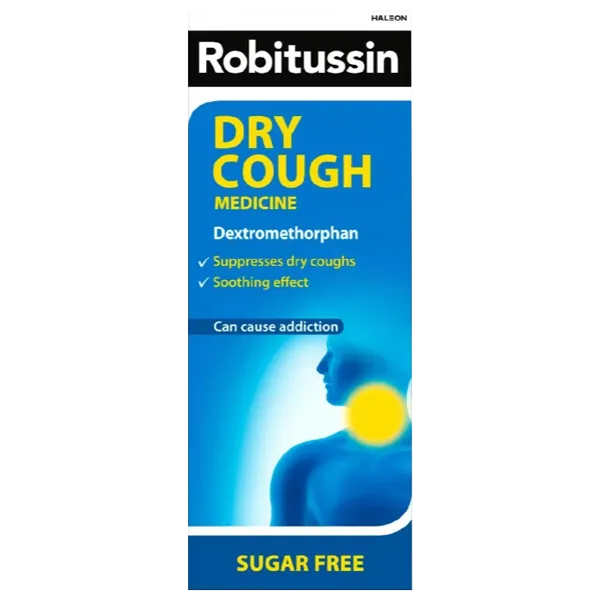
- If you are taking medicines such as certain antidepressants or antipsychotics. Robitussin Dry Cough Medicine may interact with these medicines and you may experience mental status changes (e.g. agitation, hallucinations, coma), and other effects such as body temperature above 38°C, increase in heart rate, unstable blood pressure, and exaggeration of reflexes, muscular rigidity, lack of coordination and/or gastrointestinal symptoms (e.g nausea, vomiting, diarrhoea).
Important information about some of the ingredients of this medicine:
- This medicine contains amaranth (E123), which may cause allergic reactions.
- This medicine contains sorbitol and maltitol which are sources of fructose. If you have been told by your doctor that you have an intolerance to some sugars or if you have been diagnosed with hereditary fructose intolerance (HFI), a rare genetic disorder in which a person cannot break down fructose, talk to your doctor before you take or receive this medicine.
- This medicine contains 219.3 mg of alcohol (ethanol) in each 10 ml dose which is equivalent to 22 mg/ml (2.08% w/v). The amount in 10 ml of this medicine is equivalent to less than 6 ml beer or 3 ml wine. The amount of alcohol in this medicine will not have any noticeable effects. If you are addicted to alcohol, talk to your doctor or pharmacist before taking this medicine. The alcohol in this medicine should be taken into account if you are pregnant or breastfeeding or have liver disease or epilepsy.
- This medicine contains 12.0 mg sodium benzoate in each 10 ml dose which is equivalent to 1.2 mg/ml. Sodium Benzoate may increase jaundice (yellowing of the skin and eyes) in newborn babies (up to 4 weeks old). This medicine is not for use in babies and children under 12 years.
- This medicine contains 2094 mg sorbitol per 10 ml dose which is equivalent to 209.4 mg/ml. Sorbitol may cause gastrointestinal discomfort and mild laxative effect.
- This medicine contains less than 1 mmol sodium (23 mg) per 10 ml, that is to say essentially 'sodium-free'.
Possible side effects
Like all medicines, Robitussin Dry Cough Medicine can cause side effects, although not everybody gets them. If any of the side effects gets serious or you experience any other side effects, STOP taking this medicine immediately and consult your doctor:
- Allergic reactions (rare): Symptoms could include itchy skin or rashes, difficulty breathing, faster heart rate, swelling of the face or the throat.
- Stomach upset, nausea, vomiting, abdominal discomfort (uncommon).
- Dizziness, drowsiness, mental confusion (uncommon).
- Dependency and addiction (unknown frequency) (see section "How do I know if I am addicted?").
Drug Withdrawal
When you stop taking Robitussin Dry Cough Medicine, you may experience drug withdrawal symptoms, which include restlessness, difficulty sleeping, irritability, agitation, anxiety, feeling your heartbeat (palpitations), increased blood pressure, feeling or being sick, diarrhoea, shaking, shivering or sweating.
How do I know if I am addicted?
If you notice any of the following signs whilst taking Robitussin Dry Cough Medicine, it could be a sign that you have become addicted:
- You need to take the medicine for longer than advised
- You feel you need to use more than the recommended dose
- You are using the medicine for reasons other than those indicated
- When you stop taking the medicine you feel unwell, and you feel better once taking the medicine again
If you notice any of these signs, it is important you talk to your doctor or pharmacist. If you get any side effects, talk to your doctor, pharmacist or nurse. This includes any possible side effects not listed in this leaflet. You can also report side effects directly via the Yellow Card Scheme at: www.mhra.gov.uk/yellowcard, or search for MHRA Yellow Card in the Google Play or Apple App Store. By reporting side effects you can help provide more information on the safety of this medicine.
How to store Robitussin Dry Cough Medicine
- Do not use this medicine after the expiry date shown on the top end of the carton.
- Store below 25°C.
- Keep out of the sight and reach of children.