Do not use this medicine:
- If you have ever had a bad reaction (e.g., rash, swelling of the face and throat, difficulty breathing) to any of the ingredients.
- If you are taking, or have taken in the last two weeks, drugs for depression known as Monoamine Oxidase Inhibitors (MAOIs).
- If you have recently had neurosurgery.
- If you have had your pituitary gland removed.
- For a child under 12 years old.
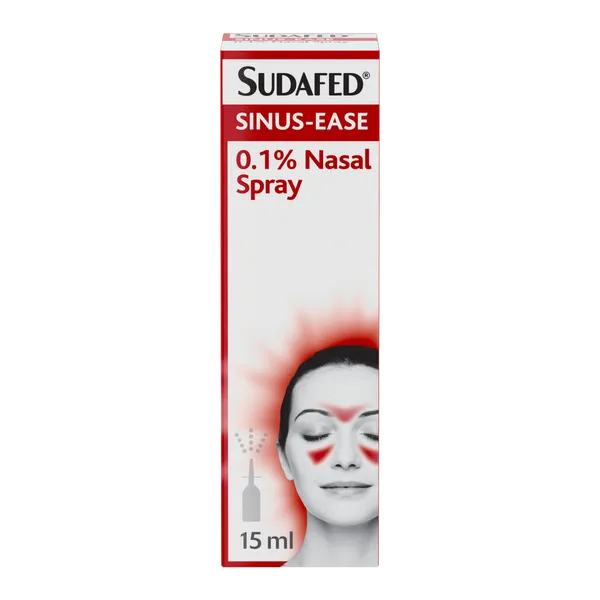
If any of these apply to you, get advice from a doctor or pharmacist without taking Sudafed Sinus-Ease 0.1% Nasal Spray.
Talk to your doctor or pharmacist if:
- You have high blood pressure or heart disease.
- You have diabetes.
- You have an overactive thyroid gland.
- You suffer from a heart disease (e.g., long QT syndrome).
If you are pregnant or breast-feeding:
If you are pregnant, or breast-feeding, think you may be pregnant or are planning to have a baby, ask your doctor or pharmacist for advice before taking this medicine.
Some of the ingredients can cause problems:
This medicine contains 1.96 mg benzalkonium chloride in each bottle of 10 ml, and 2.94 mg benzalkonium chloride in each bottle of 15 ml, which is equivalent to 0.196 mg/ml of product. Benzalkonium chloride may cause irritation or swelling inside the nose, especially if used for a long time.
Possible Side-Effects:
Like all medicines, Sudafed Sinus-Ease 0.1% Nasal Spray can have side-effects, although not everybody gets them.
- Uncommon: Nosebleeds.
- Occasionally: People may experience local irritation such as burning, soreness, dryness, stinging, itching or sneezing.
- Rarely: Nausea and headache may occur.
- If this medicine is used continuously for long periods, congestion symptoms may return.
If you get any side-effects, talk to your doctor, pharmacist or nurse. This includes any possible side effects not listed in this leaflet. You can also report side-effects directly via the Yellow Card Scheme at www.mhra.gov.uk/yellowcard or search for MHRA Yellow Card in the Google Play or Apple App Store.
Storing this medicine:
- Do not store above 25°C.
- Use within 20 weeks of opening the bottle.
- Keep the product out of the sight and reach of children.
- Do not use your medicine after the end of the month shown as an expiry date on the packaging.
- Medicines should not be disposed of via wastewater or household waste. Ask your pharmacist how to dispose of medicines no longer required. These measures will help to protect the environment.