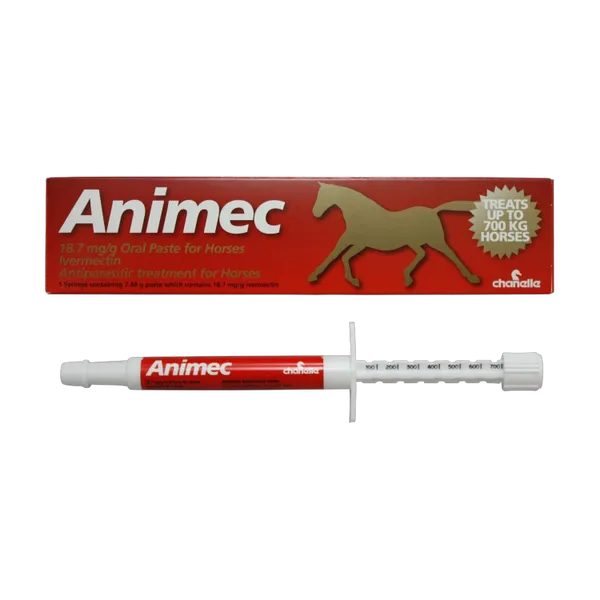
Animec 18.7mg/g Oral Paste for Horses carton with the 7.49g dose syringe, front view.

Animec 18.7mg/g Oral Paste for Horses 7.49g Syringe

£5.69
£5.69 per piece

Veterinary prescription only : our pharmacists check every order before dispatch.

You need a VET Prescription to purchase this item.

Typically dispatched within 3-5 working days. Delivery details

Animec 18.7mg/g Oral Paste for Horses contains ivermectin, used to treat infections with large and small strongyles, ascarids, pinworms, neck threadworms and stomach bots in horses. Each 7.49g syringe delivers enough paste to treat 700kg of bodyweight at the recommended dose of 0.2mg ivermectin per kg. Animec is a POM-VPS veterinary medicine.

Description

Animec ivermectin horse wormer in a 7.49g dose-graduated syringe

Ivermectin belongs to the macrocyclic lactone class of endectocides. It binds to glutamate-gated chloride channels in the nerve and muscle cells of parasites, which leads to paralysis and death of the parasite.

Animec Oral Paste for Horses is an ivermectin paste given by mouth. The syringe plunger has a screw gauge that you turn to your horse's body weight, with one syringe division treating 100kg. This 7.49g syringe holds enough paste for a horse of up to 700kg.

Key features of Animec 18.7mg/g Oral Paste for Horses:

  • Active ingredient: ivermectin 18.7mg per g of paste.
  • Treats large and small strongyles: including benzimidazole resistant strains of small strongyles (adults and luminal L4 stage larvae).
  • Also covers ascarids, pinworms, neck threadworms and stomach bots: Parascaris equorum, Oxyuris equi, Onchocerca spp. microfilariae and the oral and gastric stages of Gasterophilus spp.
  • 700kg syringe: one division per 100kg bodyweight.

Worming advice and resistance

Using the same class of wormer too often, or underdosing, increases the risk of resistance. Weigh your horse as accurately as possible before dosing, and ask your vet for advice on a dosing programme. Resistance to ivermectin has been reported in Parascaris equorum. If you think a wormer hasn't worked, speak to your vet: a faecal egg count reduction test can check for resistance. See our equine care range and other vet medicines.

FAQ

What is the difference between the Animec 6.42g and 7.49g syringes?

Both contain the same paste, 18.7mg of ivermectin per g, and use the same dose of one syringe division per 100kg bodyweight. The 6.42g syringe delivers enough paste to treat 600kg of bodyweight and the 7.49g syringe delivers enough to treat 700kg.

Can Animec horse wormer be used around dogs and cats?

Animec must not be used in dogs or cats, as severe adverse reactions may occur. Dogs (especially Collies, Old English Sheepdogs and related breeds or crosses), cats, turtles and tortoises may be affected if they eat spilled paste or get to used syringes, so keep them away from the paste and dispose of packaging carefully.

Can Animec Oral Paste be used in pregnant or lactating mares?

Yes. Animec can be used during pregnancy or lactation. It is not authorised for use in animals producing milk for human consumption.

Does Animec Oral Paste for Horses have a withdrawal period?

Yes. The withdrawal period for meat and offal is 34 days. Animec is not authorised for use in animals producing milk for human consumption.

What should I do if I think Animec isn't working on my horse?

Speak to your vet. Suspected resistance should be investigated with a test such as a faecal egg count reduction test, and if the test strongly suggests resistance, a wormer from another class with a different mode of action should be used. Resistance to ivermectin has been reported in Parascaris equorum (ascarids).

Directions

Dosage

For oral use in horses.

One syringe division of paste/100 kg body weight (based on a recommended dosage of 0.2 mg ivermectin per kg body weight).

The syringe containing 7.49 g of paste delivers sufficient paste to treat 700 kg of bodyweight at the recommended dose rate.

Administration

  1. To ensure a correct dosage, body weight should be determined as accurately as possible.
  2. The animal's mouth should be free from food to ensure swallowing.
  3. Turn the screw gauge on the syringe plunger to the body weight of the horse.
  4. The tip of the syringe barrel should be inserted at the interdental space (the gap between the front and back teeth) and the paste deposited on the base of the tongue.
  5. Advance the plunger as far as it will go, depositing the medication on the base of the tongue.
  6. Immediately elevate the horse's head for a few seconds to ensure swallowing.

Shelf life after first opening the immediate packaging: use immediately.

Patient Information Leaflet
Warnings

Before use

Do not use:

  • in case of hypersensitivity to the active substance or to any of the excipients.
  • in dogs or cats as severe adverse reactions may occur.

Special warnings:

  • Some horses with heavy infections of Onchocerca spp. microfilariae have experienced oedema and pruritus following treatment, such reactions are assumed to be the result of death of large numbers of microfilariae. These signs resolve within a few days, but symptomatic treatment may be advisable.
  • Care should be taken to avoid the following practices because they increase the risk of development of resistance and could ultimately result in ineffective therapy: too frequent and repeated use of anthelmintics from the same class over an extended period of time; underdosing, which may be due to underestimation of body weight or misadministration of the veterinary medicinal product.
  • Suspected clinical cases of resistance to anthelmintics should be further investigated using appropriate tests (e.g. Faecal Egg Count Reduction Test). Where the results of the test(s) strongly suggest resistance to a particular anthelmintic, an anthelmintic belonging to another pharmacological class and having a different mode of action should be used.
  • Resistance to ivermectin has been reported in Parascaris equorum. Therefore, the use of this veterinary medicinal product should be based on local farm epidemiological information about susceptibility of nematodes and recommendations on how to limit further selection for resistance to anthelmintics.
  • Veterinary advice should be given on appropriate dosing programs and stock management to achieve adequate parasite control and reduce the likelihood of anthelmintic resistance developing.
  • In the event that a veterinary medicinal product is suspected of being ineffective, the animal owner is advised to seek veterinary advice.

Special precautions for use in horses: Since ivermectin is highly bound to plasma proteins, special care should be taken in cases of sick animals or in nutritional conditions associated with low plasma protein levels.

Other animals: The veterinary medicinal product has been formulated for use in horses only. Cats, dogs (especially Collies, Old English Sheepdogs and related breeds or crosses) and also turtles and tortoises may be adversely affected by the concentration of ivermectin in this veterinary medicinal product if they are allowed to ingest spilled paste or have access to used syringes. Dogs and cats should not be allowed to ingest spilled paste or have access to used packaging due to the potential for adverse effects related to ivermectin toxicity.

Precautions for the person giving the paste:

  • Do not smoke, eat or drink while handling the veterinary medicinal product.
  • Wash hands after use.
  • This veterinary medicinal product may cause skin and eye irritation. Therefore, the user should avoid contact of the veterinary medicinal product with the skin and the eyes. In case of contact, rinse immediately with plenty of water.
  • In the case of accidental ingestion or eye irritation after contact seek medical advice immediately and show the package leaflet or the label to the physician.

Pregnancy and lactation: Can be used during pregnancy or lactation.

Interactions: The effects of GABA agonists are increased by ivermectin.

Withdrawal periods: Meat and offal: 34 days. Not authorised for use in animals producing milk for human consumption.

Adverse events and overdose

Adverse events in horses: None known. Reporting adverse events is important. It allows continuous safety monitoring of a veterinary medicinal product. Reports should be sent, preferably via a veterinarian, to either the marketing authorisation holder or its local representative or the national competent authority via the national reporting system.

Overdose: Mild transitory signs (slowed pupillary light response and depression) have been seen at a higher dose of 1.8 mg/kg (9 times the recommended dose level). Other signs seen at higher doses include mydriasis, ataxia, tremors, stupor, coma and death. The less severe signs have been transitory. Although no antidote has been identified, symptomatic therapy may be beneficial.

Storage and disposal

  • Do not store above 25 °C.
  • The veterinary medicinal product should not enter water courses as ivermectin is extremely dangerous to fish and other aquatic organisms.
  • Medicines should not be disposed of via wastewater or household waste. Use take-back schemes for the disposal of any unused veterinary medicinal product or waste materials derived thereof in accordance with local requirements and with any national collection systems applicable to the veterinary medicinal product concerned.
Ingredients

Active ingredient: Ivermectin 18.7 mg per g.

Other ingredients: Titanium Dioxide (E171) 20 mg per g, Hydrogenated Castor Oil, Hydroxypropylcellulose GF, Propylene Glycol.

Product Information Leaflet

External content warning: this link will take you to a third party website.
We cannot guarantee the Patient Information Leaflet is accurate and is for reference only.

View the leaflet

Ordering prescription medication is easy

Follow these simple steps

Get a prescription from your Doctor or Vet.

Place your order with us.

Add a pet and upload a prescription.

Our pharmacists will double-check your order & once approved, your order will be dispatched.