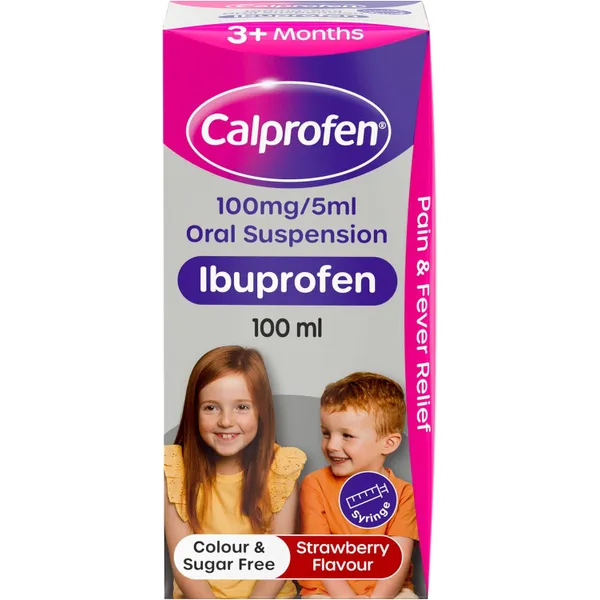
You should carefully read all product packaging and labels prior to use.
Do not give your child this medicine if:
- S/he has had a bad reaction (e.g., asthma, runny nose, swelling of face, tongue and throat, rash) after taking ibuprofen, any of the other ingredients (see section 6 of PIL), aspirin or non-steroidal anti-inflammatory (NSAIDs) painkillers.
- S/he weighs less than 5 kg.
- S/he is taking any other anti-inflammatory painkillers (NSAIDs) or aspirin with a daily dose above 75 mg.
- S/he has (or has had two or more episodes of) a stomach ulcer, perforation or bleeding.
- S/he has severe kidney, heart or liver failure.
- Immediately before or after heart surgery.
If any of these apply, get advice from a doctor or pharmacist without using CALPROFEN®.
Talk to your doctor or pharmacist if:
- Your child has an infection (this medicine may hide signs of infections such as fever and pain, potentially delaying appropriate treatment).
- Your child has or has previously had high blood pressure, heart or artery problems or a stroke.
- Your child has any conditions which may put them at risk of heart problems (e.g., diabetes, high cholesterol, family history of heart disease or stroke).
- Your child has asthma or allergic diseases of the lungs.
- Your child has or has previously had liver, kidney, heart or bowel problems, or is dehydrated.
- Your child suffers from lupus (SLE) or a similar disease.
- Your child suffers from a chronic inflammatory bowel disease such as Crohn's disease or ulcerative colitis.
- Your child is taking any other medicines, including: low-dose aspirin (up to 75 mg a day), diuretics, anticoagulants, antihypertensives, lithium, methotrexate, zidovudine, corticosteroids, cardiac glycosides, ciclosporin, mifepristone, quinolone antibiotics, SSRI antidepressants, antiplatelet drugs, tacrolimus, or any other ibuprofen preparations or NSAID painkillers.
Stop giving this medicine and immediately contact your doctor if your child experiences:
- Serious skin reactions including exfoliative dermatitis, erythema multiforme, Stevens-Johnson syndrome, toxic epidermal necrolysis, drug reaction with eosinophilia and systemic symptoms (DRESS), acute generalised exanthematous pustulosis (AGEP).
- Signs of an allergic reaction: breathing problems, swelling of the face and neck region (angioedema), chest pain.
Possible Side Effects (detailed in PIL section 4):
Like all medicines, this medicine can cause side effects. The most common side-effect is irritation of the stomach which can cause problems (e.g. indigestion, heartburn).
If your child experiences any of the following, stop giving the medicine and seek immediate medical help: blood in the faeces (stools/motions), black tarry stools, vomiting blood or dark particles that look like ground coffee, severe allergic reactions (swelling of face/throat, wheezing, rash, itching), stiff neck, headache, nausea, vomiting, fever and disorientation, severe skin reactions like DRESS syndrome, chest pain.
Other effects which may occur (talk to your doctor or pharmacist if concerned): headache, diarrhoea, wind or constipation, bleeding from an ulcer, kidney problems, stroke or heart problems, worsening of colitis and Crohn's disease, high blood pressure, skin sensitivity to light.
Ingredients that can cause problems:
- Sodium methylhydroxybenzoate (E219) and sodium propylhydroxybenzoate (E217): May cause allergic reactions which could possibly be delayed.
- Maltitol (E965): If you have an intolerance to some sugars, consult your doctor. Maltitol may have a mild laxative effect. Calorific value 2.3 kcal/g.
- Propylene glycol (E1520): Contains 4.67 mg in each 5 ml dose.
- Alcohol (ethanol): Contains 0.0005 mg in each 5 ml (less than 1ml beer/wine).
- Sodium: Contains less than 1 mmol (23 mg) per 5 ml, essentially 'sodium-free'.