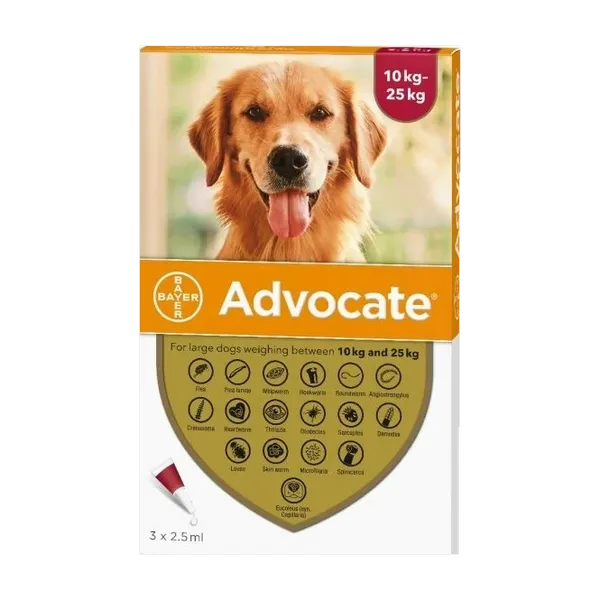
Before use
Do not use:
- in puppies under 7 weeks of age.
- in cases of hypersensitivity to the active substances or to any of the excipients.
- in dogs classified as Class 4 for heartworm disease.
- in cats: the corresponding Advocate for cats product must be used for cats.
- in ferrets: only Advocate for small cats and ferrets must be used for ferrets.
- on canaries.
Special warnings: Brief contact of the animal with water on one or two occasions between monthly treatments is unlikely to significantly reduce the efficacy, but frequent shampooing or immersion in water after treatment may reduce the efficacy. Other animals in the same household can be a source of re-infection and should be treated as necessary with an appropriate product. Unnecessary use of antiparasitics or use deviating from the instructions given in the SPC may increase the resistance selection pressure and lead to reduced efficacy. The decision to use the product should be based on confirmation of the parasitic species and burden, or of the risk of infestation based on its epidemiological features, for each individual animal.
Special precautions for use in animals:
- The treatment of animals weighing less than 1 kg should be based on a benefit-risk assessment. Use in sick and debilitated animals only based on a benefit-risk assessment.
- Do not apply in the mouth, in the eyes or the ears of the animal. Care should be taken that the product is not ingested and does not come into contact with the eyes or mouth of the treated animal or other animals.
- Do not allow recently treated animals to groom each other. Do not allow treated animals to come into contact with untreated animals until the application site is dry.
- Advocate contains moxidectin (a macrocyclic lactone): special care should be taken with Collie or Old English Sheep dogs and related breeds or crossbreeds to administer it correctly; in particular, oral uptake should be prevented.
- All dogs 6 months of age or more, living in areas endemic for heartworm, should be tested for existing adult heartworm infection before treatment. Advocate has no therapeutic effect against adult Dirofilaria immitis. Use in dogs with obvious or severe symptoms of heartworm disease should be based on a careful benefit-risk assessment by the treating veterinarian.
- Imidacloprid is toxic for birds, especially canaries.
Precautions for the person applying the product:
- This product can cause skin, eye or mouth irritation. In very rare cases it may cause skin sensitisation, transient skin reactions (for example numbness, irritation or burning/tingling sensation) or respiratory irritation in sensitive individuals.
- People with a known hypersensitivity to benzyl alcohol, imidacloprid or moxidectin should administer the product with caution.
- Avoid contact with skin, eyes or mouth. Do not eat, drink or smoke during application. Wash hands thoroughly after use. After application do not stroke or groom animals until the application site is dry.
- In case of accidental spillage onto skin, wash off immediately with soap and water. If it gets into the eyes, flush them thoroughly with water.
- If skin or eye symptoms persist, or the product is accidentally swallowed, seek medical advice immediately and show the package leaflet or label to the physician.
Environment: The product should not enter water courses as imidacloprid and moxidectin may be dangerous for fish and other aquatic organisms. Dogs should not be allowed to swim in surface waters for 4 days after treatment.
Other precautions: The solvent may stain or damage certain materials including leather, fabrics, plastics and finished surfaces. Allow the application site to dry before permitting contact with such materials.
Pregnancy, lactation and fertility: The safety has not been established during pregnancy and lactation. The use is not recommended during pregnancy and lactation. Do not use in breeding animals.
Interactions: During treatment with Advocate no other antiparasitic macrocyclic lactone should be administered. Safety when administered on the same day as an adulticide to remove adult heartworms has not been evaluated.
Adverse events and overdose
Common (1 to 10 animals in 100 treated): diarrhoea, vomiting, cough, dyspnoea, tachypnoea, inappetence, lethargy. These signs are common in heartworm positive dogs with microfilaraemia, and there is a risk of gastrointestinal signs and severe respiratory signs that may require prompt veterinary treatment.
Rare (1 to 10 animals in 10,000 treated): vomiting.
Very rare (less than 1 animal in 10,000 treated, including isolated reports): application site greasy fur, hair loss, itching or reddening (these disappear without further treatment); behavioural disorder such as agitation, inappetence and lethargy (transient, related to sensation at the application site); hypersalivation (not a sign of intoxication; disappears within minutes without treatment; correct application will minimise licking of the application site); neurological signs such as ataxia or muscle tremor (most occur transiently); pruritus.
Reporting adverse events is important. It allows continuous safety monitoring of a veterinary medicinal product. Reports should be sent, preferably via a veterinarian, to either the marketing authorisation holder or the national competent authority via the national reporting system.
Overdose: After accidental oral ingestion or overdose, neurological signs (most of which are transient) such as ataxia, generalised tremors, ocular signs (dilated pupils, little pupillary reflex, nystagmus), abnormal respiration, salivation and vomiting may occur in very rare cases. In case of accidental oral uptake, symptomatic treatment should be administered. There is no known specific antidote. The use of activated charcoal may be beneficial.
Storage and disposal
- Do not store above 30°C.
- Medicines should not be disposed of via wastewater or household waste. The product should not enter water courses as imidacloprid and moxidectin may be dangerous for fish and other aquatic organisms. Use take-back schemes for the disposal of any unused veterinary medicinal product or waste materials derived thereof in accordance with local requirements and with any national collection systems applicable.