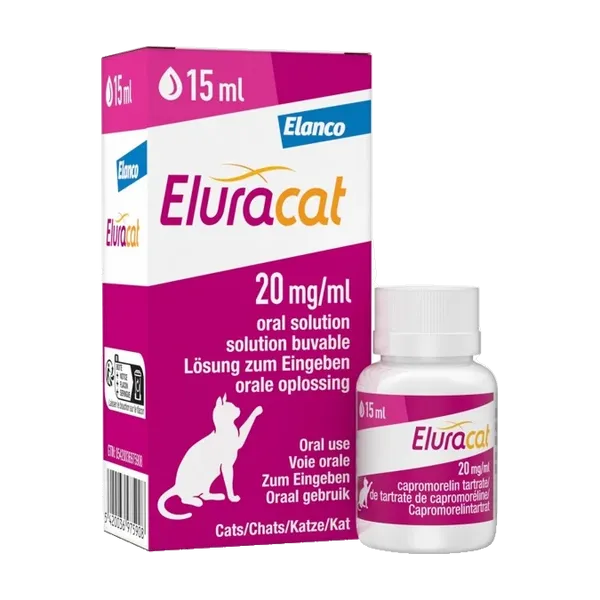
Before use
Do not use:
- in cases of hypersensitivity to the active substance or to any of the excipients.
- in patients with severe haemodynamic instability such as hypovolaemic shock.
- in patients with hypersomatotropism (acromegaly).
- during pregnancy and lactation, or in breeding animals.
Special warnings: Eluracat does not treat the underlying chronic medical conditions but is intended to provide supportive therapy. The efficacy in cats less than 6 years old or with less than 2 kg body weight has not been evaluated. The efficacy has not been established for more than 90 days.
Special precautions for use in animals:
- Eluracat has been shown to increase serum glucose levels in cats, with highly variable effects on individual cats. In non-diabetic cats homeostatic mechanisms adapt to maintain blood glucose levels within normal ranges after a few days. Use in cats with diabetes mellitus has not been evaluated; in cases of diabetes mellitus, use only according to the benefit-risk assessment by the responsible veterinary surgeon.
- Eluracat causes transient reductions in blood pressure and heart rate. In a study in eight healthy male cats, reductions of up to 30% below baseline were observed for approximately four hours following the recommended dose of 2 mg/kg; these were partially mitigated by human interaction followed by feeding. Use only according to a benefit-risk assessment by the vet in patients with congestive heart failure, cardiac arrhythmias, dehydration, anaemia or other conditions that may impair tissue perfusion or oxygenation.
- Use with caution in cats with hepatic dysfunction, as capromorelin is metabolised in the liver.
- The safety in cats less than 10 months old or with less than 2 kg body weight has not been evaluated. The safety for more than 90 days in cats with chronic medical conditions has not been evaluated.
Precautions for the person giving the product:
- Ingestion by children may cause mild and reversible signs of abdominal pain, lethargy, lightheadedness, palpitation, low back pain, feeling warm and increased perspiration. Children should not have access to filled syringes. Do not leave a filled syringe unattended. In case of accidental ingestion, seek medical advice immediately and show the package leaflet or the label to the physician.
- This product contains parabens and povidone, which may cause allergic reactions. People with known hypersensitivity to these substances should administer it with caution.
- This product may cause eye and skin irritation. Avoid contact with the eyes, skin and mucous membranes. Wash hands after use. In case of accidental eye or skin contact, rinse the affected area immediately with plenty of fresh water. If irritation persists, seek medical advice and show the package leaflet or the label to the physician.
Pregnancy, lactation and fertility: The safety has not been established during reproduction, pregnancy and lactation. Laboratory studies in rats have shown evidence of teratogenic effects. Do not use during pregnancy and lactation. Do not use in breeding animals.
Interactions: Eluracat causes transient decreases in blood pressure and heart rate for up to several hours after dosing, so concurrent use of other drugs that reduce blood pressure and/or heart rate (e.g. sedatives, anaesthetic agents, prazosin, ACE inhibitors) should only be according to a benefit-risk evaluation by the vet. It causes transient elevations in serum glucose levels and insulin resistance, so concurrent use of other drugs that cause such effects (e.g. steroids) should only be according to a benefit-risk evaluation by the vet.
Adverse events and overdose
Very common (more than 1 animal in 10 treated): hypersalivation, at the time of dosing and resolved within a few minutes.
Common (1 to 10 animals in 100 treated): diarrhoea, vomiting, anaemia, skin lesions (on the mouth and chin), dehydration, lethargy, inappetence.
Rare (1 to 10 animals in 10,000 treated): anorexia, behavioural disorder.
Very rare (less than 1 animal in 10,000 treated, including isolated reports): bradycardia, hypotension, dyspnoea, loss of consciousness, sedation, recumbency, muscle weakness, hiding.
Reporting adverse events is important. It allows continuous safety monitoring of a veterinary medicinal product. Reports should be sent, preferably via a veterinarian, to either the marketing authorisation holder or the national competent authority via the national reporting system.
Overdose: After up to 5 times the recommended dose for 6 months in young healthy cats, non-progressive increases in triglyceride levels were noted in male cats, an increase in liver to brain weight ratio was observed and liver vacuolation was noted in two animals. One male cat in the 5x group was diagnosed with diabetic ketoacidosis and had elevated serum liver parameters on day 50 of dosing. Other adverse reactions observed were consistent with those listed above.
Storage and disposal
- Do not store above 30°C.
- Shelf life after first opening the bottle: 3 months.
- Medicines should not be disposed of via wastewater. Use take-back schemes for the disposal of any unused veterinary medicinal product or waste materials derived thereof in accordance with local requirements and with any national collection systems applicable.