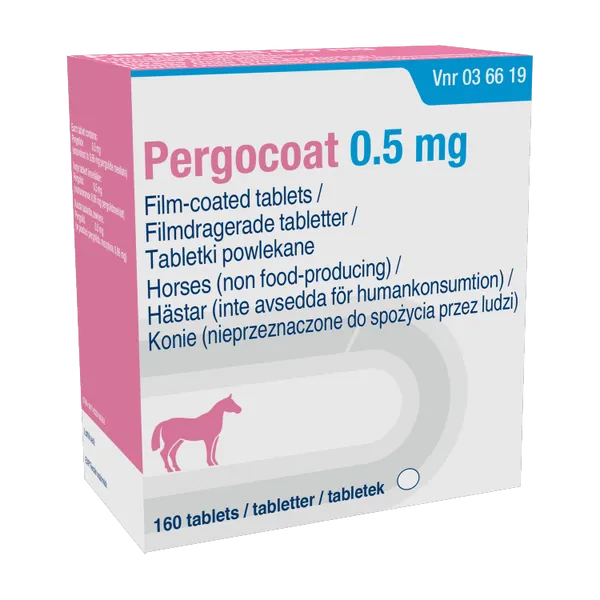
Pergocoat 0.5mg film-coated tablets for horses, carton of 160 tablets.

Pergocoat 0.5mg Film-Coated Tablet for Horses

£0.79
£0.79 per tablet

Veterinary prescription only : our pharmacists check every order before dispatch.

You need a VET Prescription to purchase this item.

Typically dispatched within 3-5 working days. Delivery details

Pergocoat 0.5mg Film-Coated Tablets for Horses contain pergolide, a dopamine receptor agonist, for the symptomatic treatment of clinical signs associated with Pituitary Pars Intermedia Dysfunction (PPID), also known as Equine Cushing's Disease. They are given by mouth once daily. Priced per tablet. Pergocoat is a POM-V veterinary medicine for horses not intended for human consumption.

Description

Pergolide for horses with PPID (Equine Cushing's Disease)

Pergolide is a synthetic ergot derivative that acts as a long-acting dopamine receptor agonist. In horses with Pituitary Pars Intermedia Dysfunction (PPID), pergolide works by stimulating dopamine receptors, and it has been shown to decrease plasma levels of ACTH, MSH and other pro-opiomelanocortin peptides.

PPID is diagnosed by your vet using endocrinologic laboratory tests alongside an evaluation of clinical signs. Lifelong treatment is anticipated, and the dose is adjusted to each horse's response.

About Pergocoat 0.5mg Film-Coated Tablets for Horses:

  • Active ingredient: pergolide 0.5mg per tablet (equivalent to 0.66mg pergolide mesilate).
  • Starting dose for 200-400kg horses: a 0.5mg daily starting dose is recommended for horses of 200 to 400kg.
  • For dose changes in 0.5mg steps: if signs have not improved, your vet may increase the total daily dose by 0.5mg at a time.
  • Once daily, by mouth: tablets can be dissolved in a small amount of water and/or mixed with molasses or other sweetener and given by syringe. Tablets should not be crushed.
  • For horses aged 2 years and over that are not intended for human consumption.
  • Priced per tablet, so your prescription can be dispensed in the quantity your vet prescribes.

Dispensed against your vet's prescription

Pergocoat is a prescription-only veterinary medicine. Your vet will repeat testing every 4 to 6 weeks while the dose is adjusted, then every 6 months once your horse is stable. A 1mg strength is also available, the starting dose for horses of 401 to 600kg. Find more for horses in our equine care range, see how we dispense pet prescriptions, or read our pet prescription questions guide.

FAQ

What is the difference between Pergocoat 0.5mg and Pergocoat 1mg?

Both contain pergolide for horses with PPID. The 0.5mg tablet is the lowest strength and the recommended starting dose for horses of 200 to 400kg. The 1mg tablet is the starting dose for horses of 401 to 600kg. Your vet decides which strength and how many tablets your horse needs.

Why might a horse be prescribed more than one Pergocoat 0.5mg tablet a day?

Pergocoat tablets can be combined to make up the daily dose your vet prescribes. If clinical signs or test results have not improved after 4 to 6 weeks, the total daily dose may be increased by 0.5mg, so 0.5mg tablets let the dose go up in single-tablet steps.

Can Pergocoat 0.5mg tablets be crushed?

No. Pergocoat tablets should not be crushed. To make them easier to give, the daily dose can be placed in a small amount of water and/or mixed with molasses or other sweetener and stirred until dissolved, then given straight away with a syringe.

Can pregnant women give Pergocoat to a horse?

Pergolide lowers prolactin levels, which poses a particular risk to pregnant and breastfeeding women. If you are pregnant or breastfeeding, avoid skin contact and hand-to-mouth contact, and wear gloves when giving Pergocoat.

What side effects can Pergocoat cause in horses?

Rare side effects (1 to 10 in 10,000 horses treated) include loss of appetite, temporary anorexia and lethargy, mild nervous system signs such as depression or unsteadiness (ataxia), diarrhoea and colic. Sweating has been reported very rarely. Contact your vet if you notice any of these or anything else unusual.

Directions

Always follow the directions and dosage given to you by your prescriber.

Dosage

Oral use, once daily. Do not use in horses less than 2 years of age.

To facilitate administration, the required daily dose should be placed in a small amount of water and/or mixed with molasses or other sweetener and agitated until dissolved. In this case, the dissolved tablets should be administered with a syringe. The whole amount should be administered immediately. Tablets should not be crushed.

Starting dose: the starting dose is about 2 µg pergolide/kg (dose range: 1.3 to 2.5 µg/kg). The maintenance dose should then be titrated according to the individual response as determined by monitoring, resulting in an average maintenance dose of 2 µg pergolide/kg bodyweight with a dose range of 0.6 to 10 µg pergolide/kg bodyweight.

Starting doses are recommended as follows:

  • Horses 200-400kg: 0.5mg daily (dosage range 1.3-2.5 µg/kg).
  • Horses 401-600kg: 1.0mg daily (dosage range 1.7-2.5 µg/kg).
  • Horses 601-850kg: 1.5mg daily (dosage range 1.8-2.5 µg/kg).
  • Horses 851-1000kg: 2.0mg daily (dosage range 2.0-2.4 µg/kg).

Your vet will prescribe the combination of tablets that makes up the dose.

Maintenance dose: lifelong treatment is anticipated for this disease. Most horses are stabilised at an average dose of 2 µg pergolide/kg body weight. Clinical improvement with pergolide is expected within 6 to 12 weeks. Horses may respond clinically at lower or varying doses; it is therefore recommended to titrate to the lowest effective dose per individual based on response to therapy, whether it is effectiveness or signs of intolerance. Some horses may require doses as high as 10 µg pergolide/kg body weight per day. In these rare situations, appropriate additional monitoring is advised.

Following initial diagnosis, repeat endocrinologic testing for dose titration and monitoring of treatment at intervals of 4 to 6 weeks until stabilisation or improvement of clinical signs and/or diagnostic testing occurs.

If clinical signs or diagnostic testing have not yet improved at the first 4 to 6 week interval, the total daily dose may be increased by 0.50 mg. In case clinical signs have improved but are not yet normalised, the veterinarian may decide to titrate or not to titrate the dose, considering the individual's response/tolerance to the dose.

In case clinical signs are not adequately controlled, it is recommended to increase the total daily dose by 0.5 mg increments (if the drug is tolerated at that dose) every 4 to 6 weeks until stabilisation occurs. If signs of dose intolerance develop, treatment should be stopped for 2 to 3 days and reinstated at one-half of the previous dose. The total daily dose may then be titrated back up to the desired clinical effect by 0.5 mg increments every 2 to 4 weeks. If a dose is missed, the next scheduled dose should be administered as prescribed.

Following stabilisation, regular clinical assessment and diagnostic testing should be performed every 6 months to monitor treatment and dose. Where there is no apparent response to treatment, the diagnosis should be re-evaluated.

Patient Information Leaflet
Warnings

Before use

Do not use:

  • in horses with known hypersensitivity to pergolide mesilate or other ergot derivatives or to any of the excipients.
  • in horses less than 2 years of age.

Special warnings: appropriate endocrinologic laboratory tests should be conducted as well as evaluation of clinical signs in order to establish a diagnosis of PPID.

Special precautions for use in horses: as the majority of cases of PPID are diagnosed in aged horses, other pathological processes are frequently present.

Precautions for the person giving the product:

  • Pergolide, like other ergot derivatives, may cause emesis, dizziness, lethargy or low blood pressure. Severe adverse events such as collapse have been observed. Ingestion may be harmful and associated with severe adverse events, especially in children or people with pre-existing heart conditions. Take utmost care to avoid accidental ingestion.
  • Avoid hand-to-mouth contact. Do not eat, drink or smoke when using this product.
  • Store and handle this product separately away from human medicinal products and handle it with great care. Replace the blister into the carton and keep it carefully away from children.
  • Tablets prepared for administration should be administered immediately and not left unattended.
  • In case of accidental ingestion, seek medical advice immediately and show the package leaflet or the label to the physician. Avoid driving or operating machinery following ingestion.
  • This product may cause eye irritation. Avoid contact with the eyes including hand-to-eye contact when handling the tablets. Minimise exposure risks when dissolving the tablets, e.g. tablets should not be crushed. In case of contact of the dissolved product with skin, wash exposed skin with water. In the event of eye exposure, flush the affected eye immediately with water and seek medical advice.
  • Wash hands after use.
  • This product may cause hypersensitivity (allergy) reactions. People with known hypersensitivity to pergolide or other ergot derivatives should avoid contact with the product.
  • This product may cause adverse effects due to decreased prolactin levels, which poses a particular risk to pregnant and lactating women. Pregnant or lactating women should avoid dermal contact or hand-to-mouth contact and wear gloves when administering the product.

Pregnancy and lactation: the safety has not been established during pregnancy or lactation. Pregnancy: use only according to the benefit/risk assessment by the responsible veterinarian. Lactation: the use is not recommended during lactation.

Interactions:

  • Use with caution in case the product is co-administered with other drugs known to affect protein binding.
  • Do not administer concurrently with dopamine antagonists, such as neuroleptics (phenothiazines - e.g. acepromazine), domperidone, or metoclopramide, as these agents may reduce the effectiveness of pergolide.

Withdrawal periods: not authorised for use in horses intended for human consumption. Treated horses may never be slaughtered for human consumption. The horse must have been declared as not intended for human consumption under national horse passport legislation. Not authorised for use in animals producing milk for human consumption.

Adverse events and overdose

Rare (1 to 10 animals in 10,000 treated): inappetence, anorexia (transient), lethargy (transient), central nervous system signs (mild, e.g. depression, ataxia), diarrhoea, colic.

Very rare (less than 1 animal in 10,000 treated, including isolated reports): sudation (sweating).

Reporting adverse events is important. It allows continuous safety monitoring of a veterinary medicinal product. Reports should be sent, preferably via a veterinarian, to either the marketing authorisation holder or its local representative or the national competent authority via the national reporting system.

Overdose: no information available.

Storage and disposal

  • Store in the original package, in order to protect from light.
  • Medicines should not be disposed of via wastewater. Use take-back schemes for the disposal of any unused veterinary medicinal product or waste materials derived thereof in accordance with local requirements and with any national collection systems applicable.
Ingredients

Active ingredient: Pergolide 0.5 mg per tablet (equivalent to 0.66 mg pergolide mesilate).

Other ingredients: Core: Lactose monohydrate, Croscarmellose sodium, Povidone, Magnesium stearate, Iron oxide yellow (E172). Coat: Polyvinylalcohol, Talc, Titanium dioxide (E171), Glycerol monocaprylocaprate, Sodium laurilsulfate, Iron oxide yellow (E172).

Product Information Leaflet

External content warning: this link will take you to a third party website.
We cannot guarantee the Patient Information Leaflet is accurate and is for reference only.

View the leaflet

Ordering prescription medication is easy

Follow these simple steps

Get a prescription from your Doctor or Vet.

Place your order with us.

Add a pet and upload a prescription.

Our pharmacists will double-check your order & once approved, your order will be dispatched.