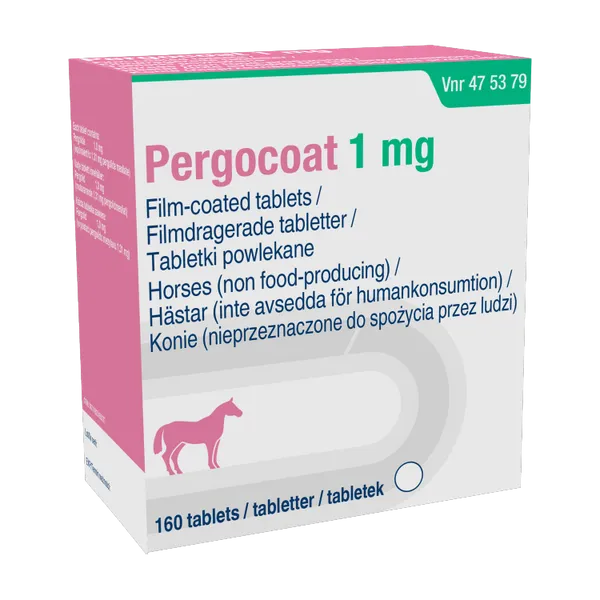
Always follow the directions and dosage given to you by your prescriber.
Dosage
Oral use, once daily. Do not use in horses less than 2 years of age.
To facilitate administration, the required daily dose should be placed in a small amount of water and/or mixed with molasses or other sweetener and agitated until dissolved. In this case, the dissolved tablets should be administered with a syringe. The whole amount should be administered immediately. Tablets should not be crushed.
Starting dose: the starting dose is about 2 µg pergolide/kg (dose range: 1.3 to 2.5 µg/kg). The maintenance dose should then be titrated according to the individual response as determined by monitoring, resulting in an average maintenance dose of 2 µg pergolide/kg bodyweight with a dose range of 0.6 to 10 µg pergolide/kg bodyweight.
Starting doses are recommended as follows:
- Horses 200-400kg: 0.5mg daily (dosage range 1.3-2.5 µg/kg).
- Horses 401-600kg: 1.0mg daily (dosage range 1.7-2.5 µg/kg).
- Horses 601-850kg: 1.5mg daily (dosage range 1.8-2.5 µg/kg).
- Horses 851-1000kg: 2.0mg daily (dosage range 2.0-2.4 µg/kg).
Your vet will prescribe the combination of tablets that makes up the dose.
Maintenance dose: lifelong treatment is anticipated for this disease. Most horses are stabilised at an average dose of 2 µg pergolide/kg body weight. Clinical improvement with pergolide is expected within 6 to 12 weeks. Horses may respond clinically at lower or varying doses; it is therefore recommended to titrate to the lowest effective dose per individual based on response to therapy, whether it is effectiveness or signs of intolerance. Some horses may require doses as high as 10 µg pergolide/kg body weight per day. In these rare situations, appropriate additional monitoring is advised.
Following initial diagnosis, repeat endocrinologic testing for dose titration and monitoring of treatment at intervals of 4 to 6 weeks until stabilisation or improvement of clinical signs and/or diagnostic testing occurs.
If clinical signs or diagnostic testing have not yet improved at the first 4 to 6 week interval, the total daily dose may be increased by 0.25 - 0.50 mg. In case clinical signs have improved but are not yet normalised, the veterinarian may decide to titrate or not to titrate the dose, considering the individual's response/tolerance to the dose.
In case clinical signs are not adequately controlled, it is recommended to increase the total daily dose by 0.25 - 0.5 mg increments (if the drug is tolerated at that dose) every 4 to 6 weeks until stabilisation occurs. If signs of dose intolerance develop, treatment should be stopped for 2 to 3 days and reinstated at one-half of the previous dose. The total daily dose may then be titrated back up to the desired clinical effect by 0.25 - 0.5 mg increments every 2 to 4 weeks. If a dose is missed, the next scheduled dose should be administered as prescribed.
Following stabilisation, regular clinical assessment and diagnostic testing should be performed every 6 months to monitor treatment and dose. Where there is no apparent response to treatment, the diagnosis should be re-evaluated.
Patient Information Leaflet