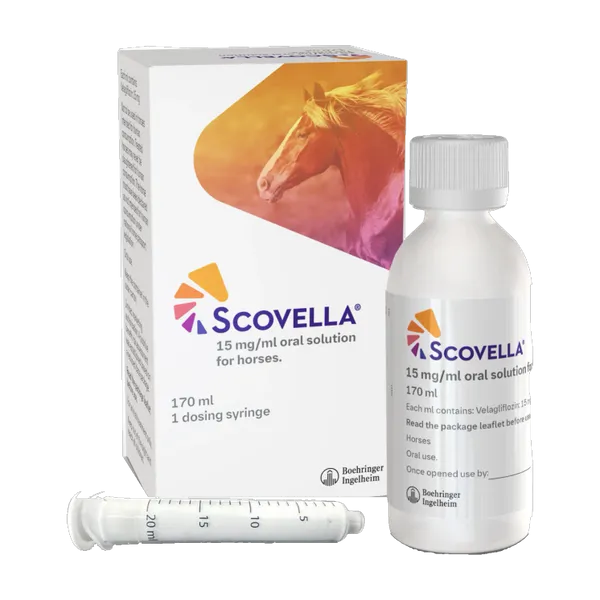
Scovella 15mg/ml oral solution for horses, 170ml carton with bottle and dosing syringe.

Scovella 15mg/ml Oral Solution for Horses 170ml

£220.00
£1.29 per 1 ml

Veterinary prescription only : our pharmacists check every order before dispatch.

You need a VET Prescription to purchase this item.

Typically dispatched within 3-5 working days. Delivery details

Scovella 15mg/ml Oral Solution for Horses contains velagliflozin, used for the treatment of hyperinsulinaemia in insulin-dysregulated horses and ponies not responsive to changes in husbandry and exercise regimen. It is given once daily by mouth or added to a small amount of feed, using the 20ml dosing syringe supplied. This pack is one 170ml bottle. Scovella is a POM-V veterinary medicine.

Description

Scovella velagliflozin for insulin-dysregulated horses and ponies

Velagliflozin is a highly selective inhibitor of the sodium-glucose co-transporter 2 (SGLT-2), which is mainly found in the kidney. Blocking SGLT-2 means glucose is eliminated in the urine, which changes glucose balance in the body and reduces pancreatic insulin secretion and circulating insulin concentrations.

Laminitis is a common clinical sign of insulin dysregulation, so your vet will confirm the diagnosis with suitable tests before treatment. Scovella cannot replace appropriate management of an insulin-dysregulated horse, which includes a dedicated diet and regular exercise where feasible, and diet changes should already be in place before treatment starts.

Key features of Scovella 15mg/ml Oral Solution for Horses:

  • Active ingredient: velagliflozin 15mg per ml.
  • Once-daily dose: 1ml per 50kg bodyweight, given at about the same time every day.
  • Into the mouth or with feed: given directly into the mouth or added to a small amount of feed.
  • 20ml dosing syringe included, marked in 1ml steps.
  • 170ml bottle: use within 3 months of first opening.

For use under veterinary direction

Scovella is a prescription-only veterinary medicine. Your vet will monitor your horse's triglyceride levels, particularly in the first weeks of treatment, and decide how long treatment should continue. See our equine care range and our guide to pet prescriptions.

FAQ

What is Scovella used for in horses?

Scovella contains velagliflozin and is used for the treatment of hyperinsulinaemia (high blood insulin) in insulin-dysregulated horses and ponies that have not responded to changes in husbandry and exercise. It does not replace a dedicated diet and regular exercise, which should continue during treatment.

How is Scovella oral solution given to a horse?

Scovella is given once daily, at approximately the same time every day, using the 20ml dosing syringe. It can be given directly into the horse's mouth or added to a small amount of feed. The syringe is marked in 1ml steps, and 1ml corresponds to 50kg bodyweight. The first withdrawal from a new bottle should not exceed 10ml. Your vet will tell you the dose.

What monitoring does a horse on Scovella need?

Your vet may measure triglyceride levels before treatment to give a baseline, and they should be monitored after treatment starts (for example after 4 to 14 days), as blood triglycerides can rise in the first weeks. The horse must always have free access to drinking water, as Scovella increases urination. Tell your vet if your horse becomes lethargic or goes off its food.

Can a horse treated with Scovella enter the food chain?

No. Scovella is not to be used in horses intended for human consumption. Treated horses may never be slaughtered for human consumption, and the horse must have been declared as not intended for human consumption under horse passport legislation.

What should I do if my horse misses a dose of Scovella?

If a dose is missed, give it as soon as possible on the same day.

Directions

Always follow the directions and dosage given to you by your prescriber.

Dosage

Oral use.

The recommended dose is 0.3 mg/kg bodyweight administered once daily.

The dosing syringe has a ml scale with 1 ml increments, corresponding to 1 ml per 50 kg bodyweight. For bodyweights in between dosing increments, rounding up to the next 1 ml increment is suggested.

The safety and the efficacy have not been investigated in horses under 3 years of age, nor in horses under 110 kg in bodyweight.

The duration and need for ongoing treatment should be determined on a case-by-case basis by the responsible veterinarian.

How to give it

  • Using the supplied dosing syringe, the product may be administered either directly into the mouth of the horse or added to a small amount of feed.
  • The first withdrawal should not exceed 10 ml, due to the vacuum present within the bottle.
  • The medication should be given at approximately the same time every day.
  • If a dose is missed, it should be given as soon as possible on the same day.
  • After administration, close the bottle tightly with the cap. Only the outside of the syringe should be rinsed with water and cleaned with a dry cloth. Keep the syringe assembled for effective use.
Patient Information Leaflet
Warnings

Before use

Do not use:

  • in horses with anorexia.
  • in horses with hyperlipaemia and associated clinical signs such as inappetence or lethargy.

Special warnings: Laminitis is a common clinical sign of insulin dysregulation (ID), so suitable endocrinologic tests should be conducted and clinical signs assessed to establish a diagnosis of ID prior to treatment. Insulin concentrations may also be influenced by seasonal variation. The effect of velagliflozin may vary depending on husbandry practices, particularly a diet high in non-structural carbohydrates. Velagliflozin treatment cannot replace appropriate husbandry management of an ID horse, which includes dedicated diet and regular exercise, as feasible.

Special precautions for use in animals:

  • An increase of triglycerides in the blood (hypertriglyceridaemia) may occur; it is usually asymptomatic and transient. Measurement of triglyceride concentrations before treatment can provide a reference for the individual horse. Triglyceride concentrations should be monitored following treatment initiation (e.g. after 4 to 14 days). If the increase is clinically significant, appropriate follow-up monitoring is indicated.
  • In horses with hypertriglyceridaemia which do not show clinical signs of hyperlipaemia (such as inappetence or lethargy), treatment can be continued based on a benefit-risk assessment by the attending veterinarian. If significant hypertriglyceridaemia persists, continuation should be revisited, taking into account co-morbidities such as hepatic lipidosis. If clinical signs of hyperlipaemia are observed, treatment should be paused until those signs are resolved.
  • If hypoglycaemia is suspected or confirmed, treatment should only be started after resolution.
  • Diet optimisation should have been implemented before starting treatment. The start of treatment should not coincide with abrupt feed restrictions or with significantly reduced feed intake.
  • Constant free access to water for drinking must be ensured, due to osmotic diuresis and potential volume depletion.
  • In clinical studies, velagliflozin at 0.3 mg/kg was given to 11 horses for 40 weeks; safety and efficacy have not been assessed beyond this duration. Biochemical parameters, including insulin, returned to pre-treatment levels within 4 weeks of stopping treatment. In one study, without husbandry changes, elevated digital pulses were observed in four of six horses after treatment stopped, and one subsequently developed laminitis.
  • The safety and efficacy have not been investigated in horses under 3 years of age, nor in horses under 110 kg in bodyweight.

Precautions for the person giving the product:

  • Accidental exposure may cause increased urination, and symptoms of low blood pressure or low blood sugar, such as dizziness. Take care to avoid children accessing an unattended filled syringe. Do not leave the syringe unattended.
  • If skin contact occurs, avoid hand-to-mouth contact, and wash hands immediately. If symptoms occur, seek medical advice.
  • The product may cause slight irritation to the eyes. Avoid contact with the eyes. If contact with the eyes occurs, rinse immediately with water, and seek medical advice if symptoms persist.
  • The product contains propylene glycol, which may cause hypersensitivity reactions. People with known hypersensitivity to this substance should avoid contact with the product.
  • As no data are available on whether exposure presents a risk to pregnant and/or breastfeeding women, they should consider wearing gloves in addition to standard hygiene practices.

Pregnancy, lactation and fertility: The safety has not been established during pregnancy or lactation. The use is not recommended during pregnancy or lactation; use only according to the benefit-risk assessment by the attending veterinarian. The use is not recommended in breeding animals.

Interactions: Direct drug-drug interactions have not been investigated in vivo. Concomitant use of pergolide and NSAIDs did not impact the safety or efficacy. Limited data are available for metformin and levothyroxine; use with other blood insulin lowering compounds has not been investigated. Concomitant treatment with diuretics has not been evaluated and may have a potential synergistic effect.

Withdrawal period: Not to be used in horses intended for human consumption. Treated horses may never be slaughtered for human consumption. The horse must have been declared as not intended for human consumption under national horse passport legislation.

Adverse events and overdose

Very common (more than 1 animal in 10 treated): elevated triglyceride. Severe hypertriglyceridaemia (above 5.7 mmol/L) is usually asymptomatic and transient.

Common (1 to 10 animals in 100 treated): weight loss, which may occur due to the glucosuric effect and the associated calorie loss and may be excessive. Undesirable weight loss can be mitigated by an appropriate diet plan in parallel to treatment.

Undetermined frequency: polyuria (increased urination) and polydipsia (increased thirst) due to the osmotic diuretic effect.

Reporting adverse events is important. It allows continuous safety monitoring of a veterinary medicinal product. Reports should be sent, preferably via a veterinarian, to either the marketing authorisation holder or its local representative or the national competent authority via the national reporting system.

Storage and disposal

  • This product does not require any special storage conditions.
  • Shelf life after first opening the bottle: 3 months.
  • Medicines should not be disposed of via wastewater. Use take-back schemes for the disposal of any unused veterinary medicinal product or waste materials derived thereof in accordance with local requirements and with any national collection systems applicable.
Ingredients

Active ingredient: Velagliflozin 15 mg per ml (equivalent to velagliflozin L-proline H2O 20.1 mg).

Other ingredients: Ethanol, Propylene glycol, Citric acid monohydrate, Sodium hydroxide, Honey flavour, Water purified.

Product Information Leaflet

External content warning: this link will take you to a third party website.
We cannot guarantee the Patient Information Leaflet is accurate and is for reference only.

View the leaflet

Ordering prescription medication is easy

Follow these simple steps

Get a prescription from your Doctor or Vet.

Place your order with us.

Add a pet and upload a prescription.

Our pharmacists will double-check your order & once approved, your order will be dispatched.