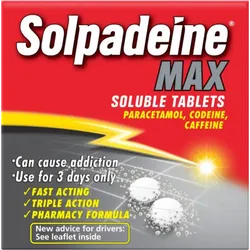
Before you take Solpadeine Max Tablets
- This medicine contains codeine which can cause addiction if you take it continuously for more than 3 days. This can give you withdrawal symptoms from the medicine when you stop taking it.
- This medicine contains paracetamol. Do not take anything else containing paracetamol while taking this medicine.
- If you take a painkiller for headaches for more than 3 days, it can make them worse.
- You must talk to a doctor if you do not feel better or if you feel worse after 3 days.
Do not take Solpadeine Max Tablets:
- If you have ever had an allergic reaction to paracetamol, codeine, other opioid painkillers or to any of the other ingredients (listed under Ingredients).
- For pain relief in children and adolescents (0-18 years of age) after removal of their tonsils or adenoids due to obstructive sleep apnoea syndrome.
- If you know that you metabolise very rapidly codeine into morphine.
- If you are pregnant or breastfeeding.
- If you have respiratory depression or chronic constipation.
Talk to your doctor or pharmacist before taking this medicine:
- If you have liver or kidney disease, including alcoholic liver disease
- If you have bowel problems including blockage of your bowel
- If you have had an operation to remove your gall bladder
- If you have hypotension or hypothyroidism
- If you have experienced a recent head injury or raised intracranial pressure.
- If you have asthma and have been told by your doctor that you are sensitive to aspirin.
- If you have Gilbert's Syndrome (familial non-haemolytic jaundice)
- If you are taking other medicines that can affect liver function
- If you have glucose-6-phosphatase dehydrogenase deficiency
- If you have haemolytic anaemia
- If you have glutathione deficiency
- If you are dehydrated
- If you have a poor diet such that the diet causes health problems
- If you weigh less than 50kg
- If you have an enlarged prostate
- If you are alcohol dependent
- If you are elderly
- If you have a condition called myasthenia gravis which weakens the muscles
- If you are taking other medicines that make you sleepy or relax your muscles (such as sleeping tablets or sedatives)
- If you are taking gabapentin or pregabalin to treat epilepsy or pain due to nerve problems (neuropathic pain)
- If you have Addison's disease, a condition where your adrenal glands do not produce enough of the hormones your body need
- If you are taken or have taking within the preceding two weeks, monoamine oxidase inhibitors (MAOIs) (antidepressants)
Immediately contact your doctor in case of overdose, even if you feel well because of the risk of irreversible liver damage.
Tolerance, dependence, and addiction: This medicine contains codeine which is an opioid medicine. It can cause dependence and/or addiction. Repeated use of opioids can result in the drug being less effective (you become accustomed to it, known as tolerance). Repeated use of Solpadeine Max Tablets can also lead to dependence, abuse and addiction, which may result in life-threatening overdose. The risk of these side effects can increase with a higher dose and longer duration of use. Dependence or addiction can make you feel that you are no longer in control of how much medicine you need to take or how often you need to take it.
The risk of becoming dependent or addicted varies from person to person. You may have a greater risk of becoming dependent on or addicted to Solpadeine Max Tablets if:
- You or anyone in your family have ever abused or been dependent on alcohol, prescription medicines or illegal drugs ("addiction").
- You are a smoker.
- You have ever had problems with your mood (depression, anxiety, or a personality disorder) or have been treated by a psychiatrist for other mental illnesses.
If you notice any of the following signs whilst taking Solpadeine Max Tablets, it could be a sign that you have become dependent or addicted:
- You need to take the medicine for longer than advised by your doctor
- You need to take more than the recommended dose
- You might feel that you need to carry on taking your medicine, even when it doesn't help to relieve your pain.
- You are using the medicine for reasons other than prescribed, for instance, 'to stay calm' or 'help you sleep'
- You have made repeated, unsuccessful attempts to quit or control the use of the medicine
- When you stop taking the medicine you feel unwell, and you feel better once taking the medicine again ('withdrawal effects')
If you notice any of these signs, speak to your doctor to discuss the best treatment pathway for you, including when it is appropriate to stop and how to stop safely.
During treatment with Solpadeine Max Tablets, tell your doctor straight away if you have severe illnesses, including severe renal impairment or sepsis (when bacteria and their toxins circulate in the blood leading to organ damage), or you suffer from malnutrition, chronic alcoholism or if you are also taking flucloxacillin (an antibiotic). A serious condition called metabolic acidosis (a blood and fluid abnormality) has been reported in patients in these situations when paracetamol is used at regular doses for a prolonged period or when paracetamol is taken together with flucloxacillin. Symptoms of metabolic acidosis may include: serious breathing difficulties with deep rapid breathing, drowsiness, feeling sick (nausea) and being sick (vomiting).
Contact your doctor if you experience severe upper abdominal pain possibly radiating to the back, nausea, vomiting or fever as this could be symptoms associated with inflammation of the pancreas (pancreatitis) and the biliary tract system.
Talk to your doctor or pharmacist if you experience pain or increased sensitivity to pain (hyperalgesia) which does not respond to a higher dosage of your medicine.
Sleep-related breathing disorders: Solpadeine Max Tablets can cause sleep-related breathing disorders such as sleep apnoea (breathing pauses during sleep) and sleep related hypoxemia (low oxygen level in the blood). The symptoms can include breathing pauses during sleep, night awakening due to shortness of breath, difficulties to maintain sleep or excessive drowsiness during the day. If you or another person observe these symptoms, contact your doctor. A dose reduction may be considered by your doctor.
Codeine is transformed to morphine in the liver by an enzyme. Morphine is the substance that produces pain relief. Some people have a variation of this enzyme and this can affect people in different ways. In some people, morphine is not produced or produced in very small quantities, and it will not provide enough pain relief. Other people are more likely to get serious side effects because a very high amount of morphine is produced. If you notice any of the following side effects, you must stop taking this medicine and seek immediate medical advice: slow or shallow breathing, confusion, sleepiness, small pupils, feeling or being sick, constipation, lack of appetite.
Prolonged use of any type of painkiller for headaches can make them worse. If this situation is experienced or suspected, medical advice should be obtained, and treatment should be discontinued.
Do not exceed the stated dose. If symptoms persist for more than 3 days or get worse, or if any other symptoms occur, treatment should be discontinued, and a physician consulted. Do not take other paracetamol or codeine-containing products concurrently.
Liver damage can happen if paracetamol is taken for a long time or in higher doses than recommended. This risk is greater with medicines that contain both paracetamol and codeine, because some people may start taking them too often due to becoming dependent on the codeine part.
Possible withdrawal effect: This medicine contains codeine and can cause addiction if you take it continuously for more than 3 days. If you become addicted, when you stop taking it you may get withdrawal symptoms. Withdrawal symptoms can include restlessness, tear flow, runny nose, yawning, muscle pain, widened/dilated pupils, difficulty sleeping, irritability, agitation, anxiety, feeling your heartbeat (palpitations), increased or restless body movements, weakness, abdominal cramps, increased respiration rate or heart rate, increased blood pressure, feeling of being sick, diarrhoea, loss of appetite, shaking, shivering or sweating. You should talk to your doctor if you think you are suffering from withdrawal symptoms.
Children and adolescents:
- Use in children and adolescents after surgery: Codeine should not be used for pain relief in children and adolescents after removal of their tonsils or adenoids due to Obstructive Sleep Apnoea Syndrome.
- Use in children with breathing problems: Codeine is not recommended in children with breathing problems since the symptoms of morphine toxicity may be worse in these children.
- Do not give to children under the age of 12 years.
Sedative medicines: Concomitant use of Solpadeine Max Tablets and sedative medicines such as benzodiazepines or related drugs (such as gabapentin and pregabalin) increases the risk of drowsiness, difficulties in breathing (respiratory depression), coma and may be life-threatening. Because of this, concomitant use should only be considered when other treatment options are not possible. However if your doctor does prescribe Solpadeine Max Tablets together with sedative medicines the dose and duration of concomitant treatment should be limited by your doctor. Please tell your doctor about all sedative medicines you are taking, and follow your doctor's dose recommendation closely. It could be helpful to inform friends or relatives to be aware of the signs and symptoms stated above. Contact your doctor when experiencing such symptoms.
Other medicines and Solpadeine Max Tablets: Talk to your doctor or pharmacist before taking these tablets if you are taking, have recently taken or might take any other medicines; particularly
- metoclopramide or domperidone (for nausea [feeling sick] or vomiting [being sick]);
- colestyramine (to lower blood cholesterol);
- monoamine oxidase inhibitors (MAOIs) prescribed for depression
- medicines that make you drowsy or sedated (e.g. benzodiazepines or related medicines).
- blood thinning drugs (anticoagulants e.g. warfarin) and you need to take a pain reliever on a daily basis, talk to your doctor because of the risk of bleeding. But you can still take occasional doses of Solpadeine Max Tablets at the same time as anticoagulants.
- medicines to treat gout and hyperuricemia (e.g. probenecid).
- other medicines that can affect your liver (e.g. barbiturates such as phenobarbitone, tricyclic antidepressants, alcohol, carbamazepine, phenytoin, primidone, rifampicin, St John's Wort).
- chloramphenicol, an antibiotic.
- anaesthetics, hypnotics, phenothiazines
Please inform your doctor or pharmacist if you are taking flucloxacillin (antibiotic), due to a serious risk of blood and fluid abnormality (called metabolic acidosis) that must have urgent treatment.
Pregnancy and breast feeding: Do not take Solpadeine Max Tablets if you are pregnant or think you might be pregnant unless you have discussed this with your doctor and the benefits of treatment are considered to outweigh the potential harm to the baby. Do not take Solpadeine Max Tablets while you are breast-feeding. Codeine and morphine passes into breast milk and will affect your baby.
Driving and using machines: This medicine can affect your ability to drive as it may make you sleepy or dizzy. Do not drive while taking this medicine until you know how it affects you. It is an offence to drive if this medicine affects your ability to drive. However, you would not be committing an offence if:
- The medicine has been taken to treat a medical or dental problem and
- You have taken it according to the information provided with the medicine and
- It was not affecting your ability to drive safely.
Talk to your doctor or pharmacist if you are not sure whether it is safe for you to drive while taking this medicine. Details regarding a new driving offence concerning driving after drugs have been taken in the UK may be found here: www.gov.uk/drug-driving-law
Sodium and lactose: This medicine contains less than 1 mmol sodium (23 mg) per 2 tablets, that is to say essentially 'sodium-free'. This medicine contains lactose. If you have been told by your doctor that you have an intolerance to some sugars, contact your doctor before taking this medicinal product.
Possible side effects
Like all medicines, this medicine can cause side effects, although not everybody gets them. If you have any unwanted side effects you should seek advice from your doctor, pharmacist or other healthcare professional.
Stop taking this medicine and tell your doctor immediately if you experience:
- Sudden inflammation of the pancreas causing severe abdominal pain and back pain, nausea and vomiting if you have recently had your gall bladder removed
- sudden, severe allergic reaction with breathing difficulty, swelling, lightheadedness, fast heartbeat, sweating and loss of consciousness
- swelling of skin or mucous membrane, face, tongue and throat causing breathing difficulties
- Very rare cases of serious skin reactions have been reported, such as: life-threatening reaction with flu-like symptoms and painful rash affecting the skin, mouth, eyes and genitals (Stevens Johnson syndrome); life-threatening reaction with flu-like effects and blistering in the skin, mouth eyes and genitals (Toxic epidermal necrolysis); inflammation of the skin induced by medicines; sudden blisters in large skin areas (Acute generalized exanthematous pustulosis)
- Breathing problems. These are more likely if you have experienced them before when taking other painkillers such as ibuprofen and aspirin
- Unexplained bruising or bleeding
- Frequent infections, fever or chills
- Nausea, sudden weight loss, loss of appetite and yellowing of the eyes and skin.
- Cloudy urine or difficulties urinating
- A serious condition that can make blood more acidic (called metabolic acidosis), in patients with severe illness using paracetamol (see above): Frequency "Not known" (frequency cannot be estimated from the available data).
When using this product you may experience:
- Uncommon side effects (affecting 1 in 1,000 to 1 in 100 people): Drug withdrawal syndrome
- Rare side effects (affecting 1 in 10,000 people to 1 in 1,000 people): Allergic reactions
- Very rare side effects (affecting less than 1 in 10,000 people): Allergic reactions of the skin with rash, itching, sweating, rash of raised red or purple spots, the spots look like small bruises or blood spots, hives; Cloudy urine
- Side effects with frequency not known (frequency cannot be estimated from the available data): Liver impairment; Drug dependency after prolonged use; Constipation; Nausea; Vomiting; Heartburn; Dry mouth; Dizziness; Pain or increased sensitivity to pain (hyperalgesia) which does not respond to a higher dosage of your medicine; Worsening of headache with prolonged use; Drowsiness; Difficulty with urination; Itching or sweating; Problem affecting a valve in the intestines (sphincter of Oddi dysfunction)
Reporting of side effects: If you get any side effects, talk to your doctor, pharmacist or nurse. This includes any possible side effects not listed here. You can also report side effects directly via the Yellow Card Scheme at: www.mhra.gov.uk/yellowcard or search for MHRA Yellow Card in the Google Play or Apple App Store. By reporting side effects you can help provide more information on the safety of this medicine.
How do I know if I am addicted? If you take this medicine according to the instructions on the pack, it is unlikely you will become addicted to the medicine. However, if you notice any of the following signs, it is important that you talk to your doctor: you need to take the medicine for longer periods of time; you need to take more than the recommended dose; you are using this medicine for reasons other than instructed; when you stop taking the medicine you feel very unwell, but you feel better if you start taking the medicine again.
Storage
- Keep out of the reach and sight of children.
- Do not use this medicine after the 'EXP' date shown on the pack.
- Store this medicine in a safe and secure storage space, where other people cannot access it. It can cause serious harm and be fatal to people when it has not been intended for them.